Prediction markets are no longer just a niche hobby for crypto enthusiasts and financiers. A new study reveals that Generation Z sees these platforms not merely as a tool for earning money, but as a significant part of modern culture that could displace traditional sports betting in the future.
Generational Shift: Gen Z and Millennials at the Helm
According to a fresh report by The New Consumer and Coefficient Capital, which surveyed over 3,000 Americans, young people are becoming the main drivers of the prediction industry.
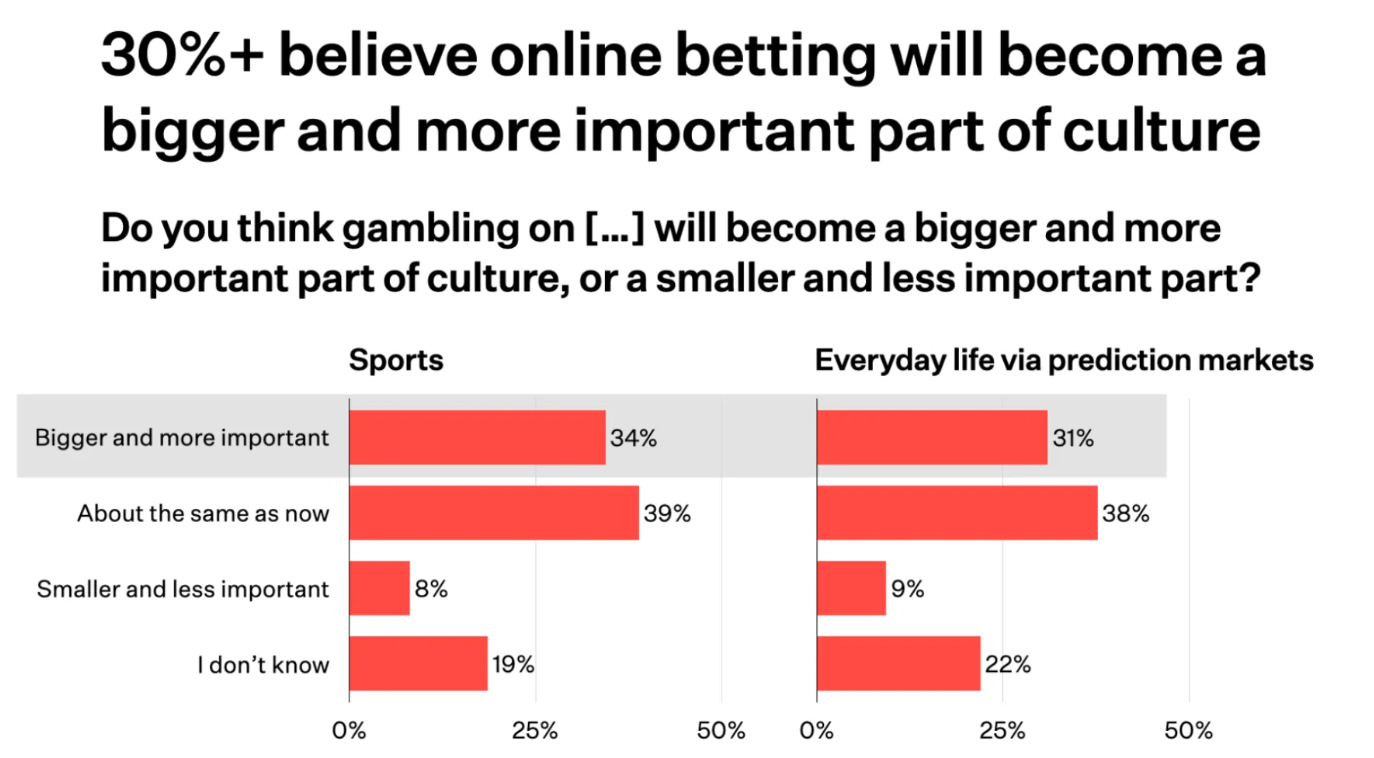
For a third of young respondents, prediction markets represent the future. 31% believe this sector will become an integral part of the cultural code. However, the awareness gap between generations remains colossal:
- Gen Z and Millennials: Awareness of Polymarket is 17%, and Kalshi is 13%.
- Gen X and older: Only 4–5% know about these platforms.
The Battle for Betting
Young Americans have not yet decided who will be the “king” of future gambling entertainment. Opinions are split almost evenly:
- 34% bet on the dominance of classic sports betting.
- 31% believe in the victory of prediction markets.
- About 39% think both directions will maintain their significance in parallel.
Financial Boom: January 2026 Records
The industry is experiencing explosive growth. In less than a full month of January alone, the total volume of prediction platforms broke the historic $10 billion mark.
Competition among platforms is heating up. Currently, three giants hold the lead
| Platform | Volume (January) | Key Features / Investors |
| Kalshi | > $3 billion | Market leader. Company valuation reached $11B (Sequoia, a16z, Paradigm). |
| Opinion | $2.8 billion | Backed by YZi Labs and Changpeng Zhao (Binance founder). |
| Polymarket | $2.7 billion | Valuation $9B. Investment from ICE (NYSE). Partnerships with WSJ and MLS. |
Investors are actively pouring capital into the sector. Polymarket, having received $2 billion from the operator of the New York Stock Exchange (ICE), is currently negotiating a new funding round that could raise its valuation to $12–15 billion.
Development Strategies: Sports vs. Politics
Key market players have chosen different vectors to scale their success.
Polymarket: Betting on Sports and Media
Polymarket aims to become a mass-market product through integration into major sports and financial media.
- MLS Deal: The platform signed an exclusive partnership with Major League Soccer (MLS). Polymarket will now create prediction markets for matches, including the MLS Cup and the All-Star Game.
- Fan Engagement: There are plans to introduce interactive “second screens” during broadcasts, allowing viewers to make predictions in real-time.
- Media Expansion: At the beginning of the year, Polymarket became a data provider for The Wall Street Journal, having previously integrated with Yahoo Finance and Google Finance.
“As the soccer audience in the U.S. grows and evolves, fans are looking for new ways to get deeper into the game,” commented Polymarket CEO Shane Coplan.
Kalshi: Lobbying and Government Relations
Kalshi has chosen the path of strengthening ties with regulators. The company opened a new office in Washington, D.C., and is actively hiring specialists with political backgrounds:
- John Bivona (former White House liaison to the Department of Homeland Security under Biden) has been appointed as the Head of Federal Government Relations.
- Blake Bee (former senior manager for public policy at Amazon) will handle operations at the state level.
Conclusion
The prediction market is transforming from a highly specialized financial instrument into a full-fledged entertainment and analytics industry. While Polymarket captures the attention of sports fans and business press readers, Kalshi is cementing its position in government offices. One thing is clear: Generation Z has already made its choice, and that choice is to predict everything.