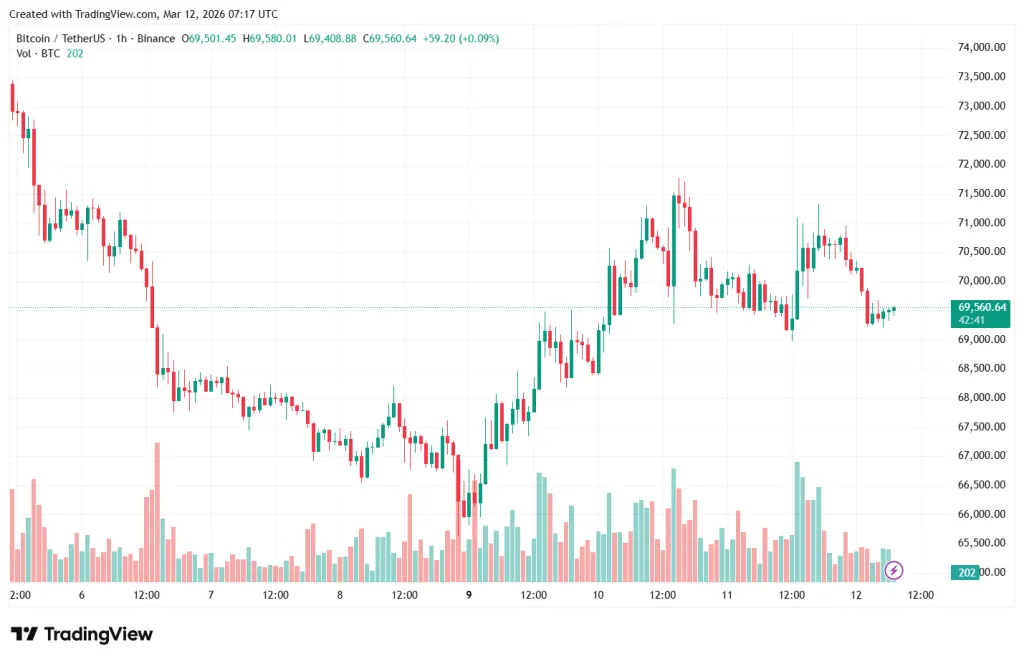
The leading cryptocurrency has once again forced analysts to redraw their models. Defying skeptical forecasts, Bitcoin tested the $71,000 mark. However, behind this rally lies a fierce clash of opinions: while some see digital gold as a maturing asset, others predict a plunge into the abyss.
The Bearish Manifesto: Is Bitcoin Headed to $10,000?
Mike McGlone, Senior Macro Strategist at Bloomberg Intelligence, remains steadfast in his pessimism. In his view, the current surge is merely a temporary episode before a massive collapse.
- The Strategist’s Arguments: Macroeconomic pressure and an excess of market speculation.
- Lost Independence: McGlone emphasizes that with the arrival of institutional investors, BTC has begun moving in lockstep with traditional assets, ultimately losing its status as an “independent safe haven.”
- Recommendation: Treat local price spikes solely as opportunities to book profits before the bear cycle concludes.
Opponents: “To Hit $10,000, You’d Have to Destroy the Internet”
The Bloomberg strategist’s forecast met a wave of criticism from the expert community:
- Mati Greenspan (Quantum Economics) believes a drop to $10,000 is unrealistic without a global liquidity collapse or the physical destruction of the World Wide Web.
- Jonathan Randin (PrimeXBT) suggests the market bottom was already reached in 2022. His outlook is more conservative: consolidation within the $60,000–$70,000 range, with a possible but brief sprint toward $80,000.
- Jason Fernandes (AdLunam) allows for a slide to $28,000, but only in the event of extraordinary financial stress, rather than a simple economic slowdown.
Market Dynamics: Oil Down, Crypto Up
Currently, Bitcoin is holding steady around $70,000. Interestingly, the rally was catalyzed by a sharp decline in oil prices. While the Nasdaq 100 and S&P 500 indices are stagnating, the crypto market is showing remarkable resilience.
Breaking the Mold
Bitcoin has begun to demonstrate independence from the tech sector.
5-Day Statistics:
- BlackRock Spot ETF (IBIT): +3.75%
- iShares Software Tech Fund: -2.45%
Nansen analyst Aurelie Barthere notes the digital asset’s “immunity” to geopolitical shocks. According to her, BTC’s sensitivity to negative news is currently lower than that of European equity indices, signaling that seller exhaustion may have set in.
A New Role: From “Risk Asset” to “Digital Hedge”
The relationship between Bitcoin and gold is also shifting. Brian Tan of Wintermute noticed a sharp reversal in correlation: it swung from negative (-0.49) to positive (+0.16). Bitcoin is now rising in tandem with precious metals amid a weakening dollar, ceasing to be the asset investors dump at the first sign of danger.
The ETF Factor: Is the Capitulation Phase Over?
Institutional interest is backed by the numbers:
- IBIT Inflows: In March alone, the fund attracted nearly $1 billion.
- End of Outflows: Following a $3 billion loss between November and February, the market seems to have found its footing.
- Outlook: Experts expect the recovery to continue into the second quarter, provided current demand holds.
Potential Pitfalls: Inflation and Energy
Despite the optimism, Sebastian Serrano, CEO of the Ripio exchange, warns that Bitcoin remains sensitive to energy costs. Expensive oil drives inflation, forcing central banks to keep interest rates high. This restricts the liquidity influx essential for a sustained bull trend.
Lawrence Fraussen (Kaiko) goes a step further, arguing that the “inflation hedge” myth has been debunked: Bitcoin remains a volatile instrument that, in the event of a global stock market crash, would likely follow equities downward.