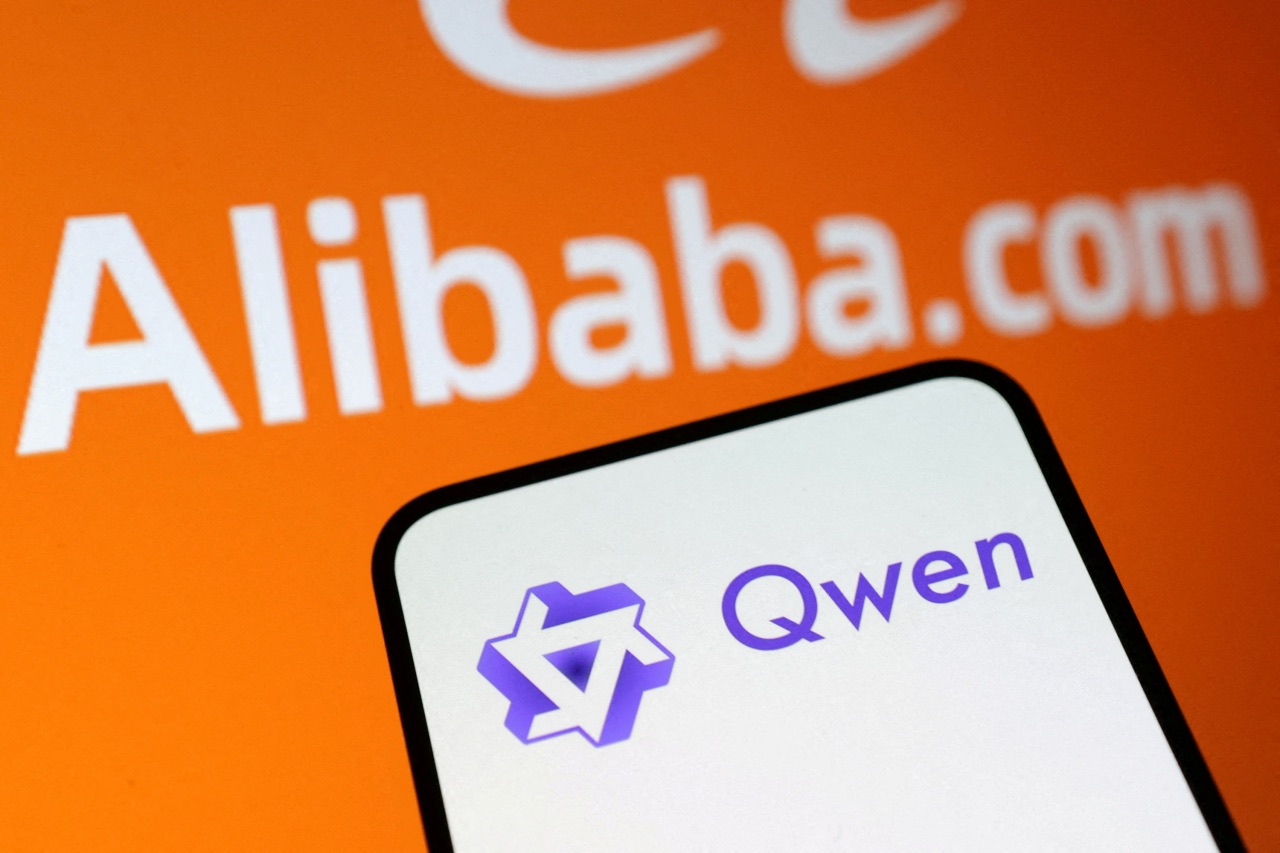
Chinese tech giant Alibaba is breaking records in the artificial intelligence market. Over the past six months, its family of open Qwen models has been downloaded over 3 billion times, radically changing the balance of power in the open-source industry and leaving renowned Western competitors behind.
By opening access to more than 460 neural networks, Alibaba triggered a massive chain reaction in the global developer community. Around 300,000 derivative software products have already been built based on these technologies. According to a recent company statement cited by Bloomberg, the adoption rate of Qwen is showing unprecedented growth.
Dominance on the Hugging Face Platform
The numbers speak for themselves. A semi-annual report by the independent AI platform Hugging Face notes that in the first seven months of 2026 alone, the Qwen architecture was downloaded 2.05 billion times. By comparison, the figures for American tech giants look much more modest: Google models were downloaded 418 million times during the same period, and Meta releases 227 million times. It is worth noting that this statistic only reflects activity within the Hugging Face ecosystem, excluding direct API requests and private server deployments.
In addition to the number of downloads, Alibaba models unconditionally lead in the level of independent community engagement. The number of derivative repositories based on Qwen reached 151,448 (compared to 82,506 for Google), and this list grows by 180–210 new projects daily. Moreover, out of 28,500 GGUF conversions (versions optimized to run on standard consumer computers), only 54 were created by Alibaba itself. The rest of this colossal work was done by enthusiasts.
“Qwen models have become an integral part of the standard workflow for developers worldwide, who choose which base to use for fine-tuning and final deployment,” Hugging Face analysts note.
The Secret to Success: From Micro-Models to Giants
Analysts highlight three key factors that ensured Qwen’s leadership:
- Regular updates and continuous code optimization.
- The broadest possible range of scales: Alibaba offers both compact sub-billion versions for smartphones and the colossal Qwen3.8-Max with 2.4 trillion parameters.
- The free Apache 2.0 license, which, unlike many proprietary agreements, does not restrict the modification and commercial use of AI.
The breadth of the model lineup proved to be a decisive trump card. Hugging Face statistics clearly demonstrate the real needs of the industry: 83% of all downloads in the platform’s history fall on lightweight models (under 1 billion parameters). At the same time, heavy neural networks with over 100 billion parameters account for a mere 1%.
Alibaba’s leadership is especially noticeable in the local deployment segment (GGUF builds):
- Qwen (Alibaba) — 39.6 million downloads per month
- Gemma (Google) — 20.8 million downloads per month
- Llama (Meta) — 7.5 million downloads per month
Against this backdrop, AI labs focused exclusively on creating massive language models are rapidly losing their audience. A striking example is the startup Moonshot AI, which releases almost no solutions smaller than 70 billion parameters: over the entire year, the company garnered only 37 million downloads, which is about 55 times less than Qwen.
Paradigm Shift: China vs. USA
Alibaba’s success is not an isolated case, but a marker of a global shift in the balance of the open artificial intelligence market. Almost every month in 2026, the largest open-source model from China surpassed all new American releases in size. The “ceiling” of Chinese neural networks ranged from 754 billion to 2.78 trillion parameters, while for US competitors in five out of seven months, it did not exceed the 130 billion mark.
Approaches to technology openness also differ fundamentally. In China, 59% of models with more than 20 billion parameters are published under the free Apache 2.0 license, and another 22% under the MIT license. None of them have restrictions on commercial use. The American strategy remains much more conservative and closed: only 29% of models use Apache/MIT licenses, 41% are distributed under proprietary terms, and 30% are published without a clearly specified legal framework.
It is highly symptomatic that in the US today, the locomotive of open AI is not software labs and social networks, but semiconductor manufacturers. AMD and Nvidia each released over 200 repositories, noticeably outpacing Google and Meta in the number of new open releases.
And yet, despite the clear successes of Chinese open developments, it is too early to discount American dominance. As Alex Capri, author of the book Techno-Nationalism, noted in August, today the United States maintains its advantage in the AI race not so much due to the technological perfection of individual algorithms, but thanks to total control over the underlying computing infrastructure. This factor currently remains the main barrier to China’s complete dominance in the field of AI.