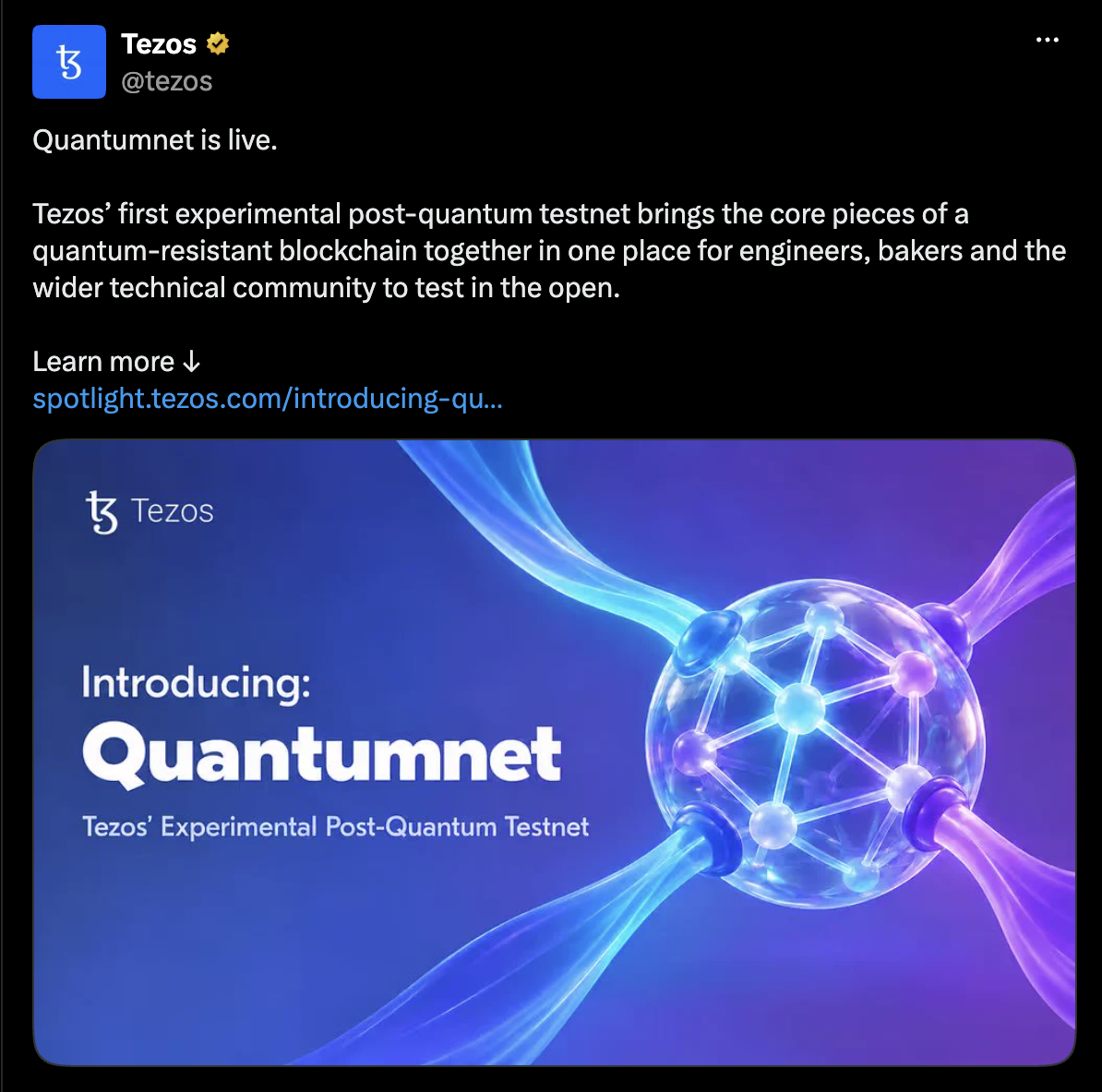
The blockchain industry has reached a turning point where the hypothetical threat posed by quantum computers is beginning to transform into a practical engineering task. Developers in the Tezos ecosystem—engineers from Nomadic Labs, Trilitech, and other partner organizations—have announced the launch of Quantumnet. This is the first experimental testnet built for a comprehensive evaluation of a decentralized protocol operating under a fully post-quantum architecture.
The network is already open for public testing, application developers, and node operators. Team representatives emphasize that Quantumnet is not a preview or a “release candidate” for a ready-made mainnet upgrade. It is a research playground designed to assess how new cryptographic primitives impact performance, block size, and hardware requirements.
Architectural Shift: Tezos Mainnet vs. Quantumnet
Transitioning a decentralized network to post-quantum cryptography cannot be achieved by a simple, pinpoint replacement of user signature algorithms. Sufficiently powerful quantum computers running Shor’s algorithm could potentially break not only basic asymmetric cryptography on elliptic curves, but also signature aggregation mechanisms in consensus, randomness generation schemes, and cryptographic commitments in scaling layers.
For this reason, modifications in Quantumnet affect nearly every layer of the blockchain stack:
| Architectural Layer | Standard Tezos Mainnet | Experimental Quantumnet | Purpose of Change |
| Account Signatures | Ed25519 / Secp256k1 / P-256 | ML-DSA-44 (FIPS 204) | Protect user keys (tz5 prefix) from quantum attacks. |
| Consensus Aggregation | BLS12-381 signatures | XMSS aggregated via STARK | Eliminate vulnerable pairing-based crypto schemes in block validation. |
| Randomness for Baking | VDF (Verifiable Delay Functions) | Smooth Weighted Round Robin | Replace VDF in favor of deterministic rights distribution among bakers. |
| Data Availability Layer (DAL) | KZG Commitments | ZODA Cryptographic Commitments | Switch to quantum-resistant commitments without critical traffic growth. |
| Private Payments | Sapling (zk-SNARKs) | Temporarily excluded (parallel test: TzEL) | Remove vulnerable schemes until stable post-quantum counterparts are created. |
Deep Dive into Technical Changes
1. User Layer and ML-DSA-44 Signatures
To protect user funds, Quantumnet replaces traditional elliptic curves with the lattice-based signature scheme ML-DSA-44 (formerly known as CRYSTALS-Dilithium). This algorithm was officially standardized by the U.S. National Institute of Standards and Technology (NIST) under FIPS 204.
Basic support for the tz5 address prefix was previously incorporated into Tezos’s architecture, but it was never activated on the mainnet. In Quantumnet, tz5 addresses become the primary standard for conducting transactions.
2. Block Validation: From BLS to Hash-Based XMSS and STARKs
In standard blockchains, validators use BLS signatures because they can be easily combined (aggregated) mathematically, saving block space. However, BLS relies on elliptic curves and pairing-based cryptography, which are vulnerable to quantum computing.
In Quantumnet, BLS signatures are replaced with XMSS (Stateful Hash-Based Signature Scheme)—a structure built on hash trees. Because XMSS signatures are significantly larger and harder to aggregate, developers deployed zk-STARK technology. STARK proofs compress multiple XMSS signatures into a single, compact, quantum-resistant mathematical proof.
3. Baking Rights Distribution Without VDF
In Tezos, the process of validating and creating blocks is called baking. On the mainnet, a Verifiable Delay Function (VDF) is used for unpredictable, random baker selection. However, modern VDF implementations rely on mathematical groups of unknown order, which are vulnerable to quantum attack.
For Quantumnet, engineers completely abandoned VDF in favor of the Smooth Weighted Round Robin algorithm. This deterministic mechanism distributes block creation rights strictly in proportion to each baker’s staking share (their monetary balance). This temporarily simplifies the architecture and guarantees the quantum resilience of the baker selection process.
4. Post-Quantum DAL: Moving from KZG to ZODA
The Data Availability Layer (DAL) is necessary for Tezos to scale horizontally and support rollups. Traditionally, KZG (Kate-Zaverucha-Goldberg) commitments are used to verify data availability.
In Quantumnet, KZG schemes are replaced with the ZODA algorithm. According to developers, ZODA removes quantum-vulnerable cryptographic primitives without placing critical demands on network throughput or causing massive data inflation between nodes.
Privacy and Functional Limitations of the First Iteration
Building a post-quantum network requires temporary functional compromises. The initial version of Quantumnet excludes two popular modules from the main Tezos protocol:
- Sapling: The module providing shielded (private) transactions was disabled because its zk-SNARK implementation uses a trusted setup vulnerable to quantum analysis.
- Timelock Puzzles: The mechanism for time-delayed decryption was removed similarly to VDF due to mathematical vulnerabilities in its underlying primitives.
Research into post-quantum privacy is proceeding in a parallel experiment. In May 2026, the Tezos team introduced TzEL, a prototype for confidential payments built on a combination of quantum-resistant cryptography and zk-STARK proofs. While TzEL is not integrated into the current build of Quantumnet, it may be included in future iterations.
Node Load, Hardware Requirements, and Governance
Tezos co-founder Arthur Breitman noted in a publication on Tezos Spotlight that the key objective of Quantumnet is not merely launching new algorithms, but measuring the real-world “cost” of post-quantum protection under live conditions.
Post-quantum signatures and proofs demand substantially more memory and computational resources to generate and verify. Preliminary tests reveal:
- Data Size: ML-DSA and XMSS public keys and signatures are several times larger than classic ECDSA/Ed25519 counterparts.
- Computational Load: Node operators require greater CPU power to process aggregated STARK proofs.
- Preserving Decentralization: Despite higher requirements, Quantumnet is designed so that block validation can still run on standard consumer hardware (commodity PCs and basic servers), maintaining a low barrier to entry for bakers.
There is no fixed timeline for migrating Quantumnet solutions to the Tezos mainnet. The project is planned for long-term testing. As individual modules (such as ML-DSA signatures or consensus aggregation) complete testing, they can be submitted to community voting as standard protocol upgrades via Tezos’s on-chain governance mechanism.
Context: Setting Post-Quantum Standards in Web3
The Tezos initiative is unfolding alongside a broader industry shift toward post-quantum security:
- Bitcoin Quantum: In January, BTQ Technologies launched Bitcoin Quantum, a dedicated testnet fork of Bitcoin testing ML-DSA signatures for transactions.
- Institutional Pilots: In August, Safeheron and the Responsible Fintech Institute, alongside banks and financial regulators, launched a pilot project to integrate post-quantum cryptography into digital asset wallets and interbank transfer systems.
The Quantumnet testnet demonstrates Tezos’s proactive strategy: rather than scrambling to replace algorithms when a quantum threat becomes immediate, the ecosystem is testing and refining a full-stack transformation of the blockchain in advance.