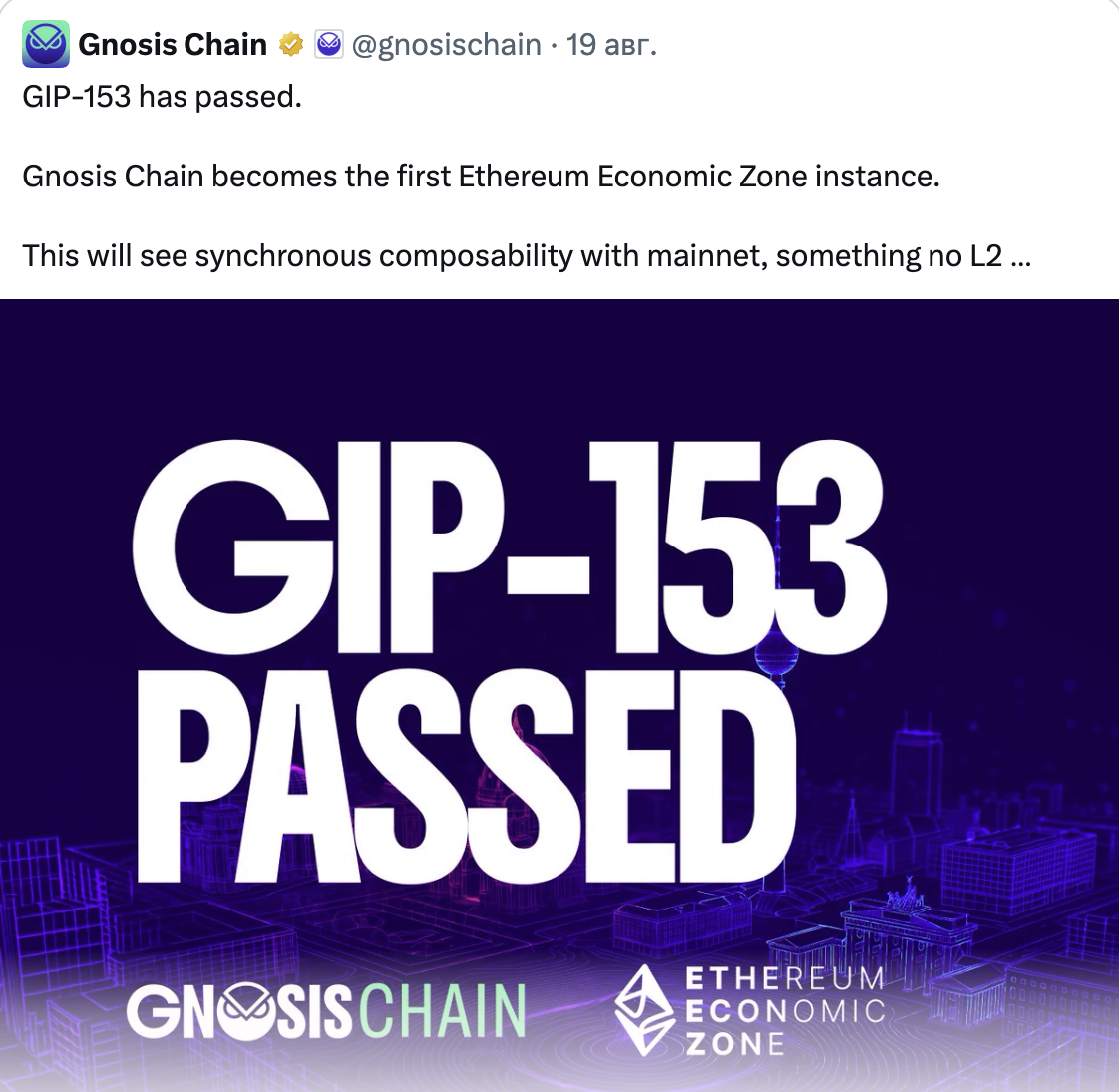
The era of isolated Layer-1 blockchains is coming to a rapid end. GnosisDAO token holders have made a landmark decision: Gnosis Chain is officially stepping down as an independent Layer-1 blockchain to transform into a Layer-2 (L2) ZK-rollup settling directly on the Ethereum mainnet.
This decision doesn’t just reshape the architecture of one of the market’s oldest networks—it marks the debut of a new scaling paradigm: the Ethereum Economic Zone (EEZ).
A Historic Choice: GIP-153 Voting Results
The vote on proposal GIP-153 ended in an overwhelming victory for proponents of the transition. The community showed rare unanimity, exceeding the required quorum by nearly 65%:
- For: 123,158 GNO
- Against: 115 GNO
- Abstained: 151 GNO
Market reaction was immediate: following the announcement, the GNO token surged by over 7% in 24 hours, pushing past the $123 mark.
What is the EEZ Framework, and What is Its Main Advantage?
Gnosis Chain will become the first practical implementation of the Ethereum Economic Zone (EEZ) architecture—a cutting-edge framework co-developed by Gnosis and ZisK with direct financial and technical backing from the Ethereum Foundation.
The primary issue in today’s Web3 space is fragmentation. While dozens of L2 networks currently exist (Arbitrum, Optimism, Base, etc.), they remain siloed from each other and from Ethereum mainnet. Moving funds or triggering contracts across networks requires cross-chain bridges—traditionally the most vulnerable attack vector in crypto.
Key Innovation of EEZ: Atomic Composability.
An application running on Gnosis Chain will be able to query smart contracts or deep liquidity on Ethereum within the exact same transaction, eliminating the need for traditional cross-chain bridges.
What Changes for Users and Developers?
Despite the sweeping architectural overhaul under the hood, the migration is designed to be entirely seamless for end users.
- No Migrations or Address Changes: All user balances, transaction histories, existing smart contracts, and state data will remain intact.
- Gas Token:xDAI will stay as the native token for paying network transaction fees.
- Security: The network will fully deprecate its own validator set. Transaction finality and data availability will rely entirely on Ethereum’s economic security and validator base.
Rebooting GNO Tokenomics
Moving away from an independent consensus mechanism fundamentally alters GNO’s economic structure:
- Massive Unlock: Approximately 350,000 GNO (roughly 27% of the total circulating supply) will be unlocked from network staking.
- End of Subsidies: The DAO will stop paying out staking subsidies from its treasury, reducing inflationary pressure on the asset.
- New Value Drivers: Developers plan to tie GNO’s value directly to network revenues. Two primary models are under consideration: direct revenue distribution to token holders or programmatic market buybacks. The final design will be put to a separate vote.
Unfiltered Self-Criticism: Why L1s and Classic L2s Fall Short
In GIP-153, the proposal’s authors candidly admitted that Gnosis Chain’s original vision as an independent L1 failed to stay competitive.
Standalone L1 networks with lower liquidity and security offer little incentive for users and DeFi protocols to abandon Ethereum. Simultaneously, launching yet another standard L2 rollup wouldn’t solve the problem either—over 100 competing solutions already fight for the same pool of total value locked (TVL).
A Trade-Off for Speed: Developers openly acknowledge a temporary compromise on decentralization. The high-speed block generation architecture required for EEZ will initially demand partial centralization of sequencing infrastructure, though the system will fully decentralize as real-time ZK-proof generation matures.
Implementation Roadmap
The rollout will proceed in distinct phases:
- December 2026 – January 2027: Testnet deployment and initial mainnet release of the updated ZK-rollup network.
- Throughout 2027: Full deployment of the EEZ ecosystem, featuring seamless two-way interoperability with Ethereum and real-time ZK-proof generation.
The transformation of Gnosis Chain sets a significant precedent for the crypto industry, signaling that the future of infrastructure lies not in building isolated networks, but in deep, trust-minimized integration with Ethereum’s base layer.