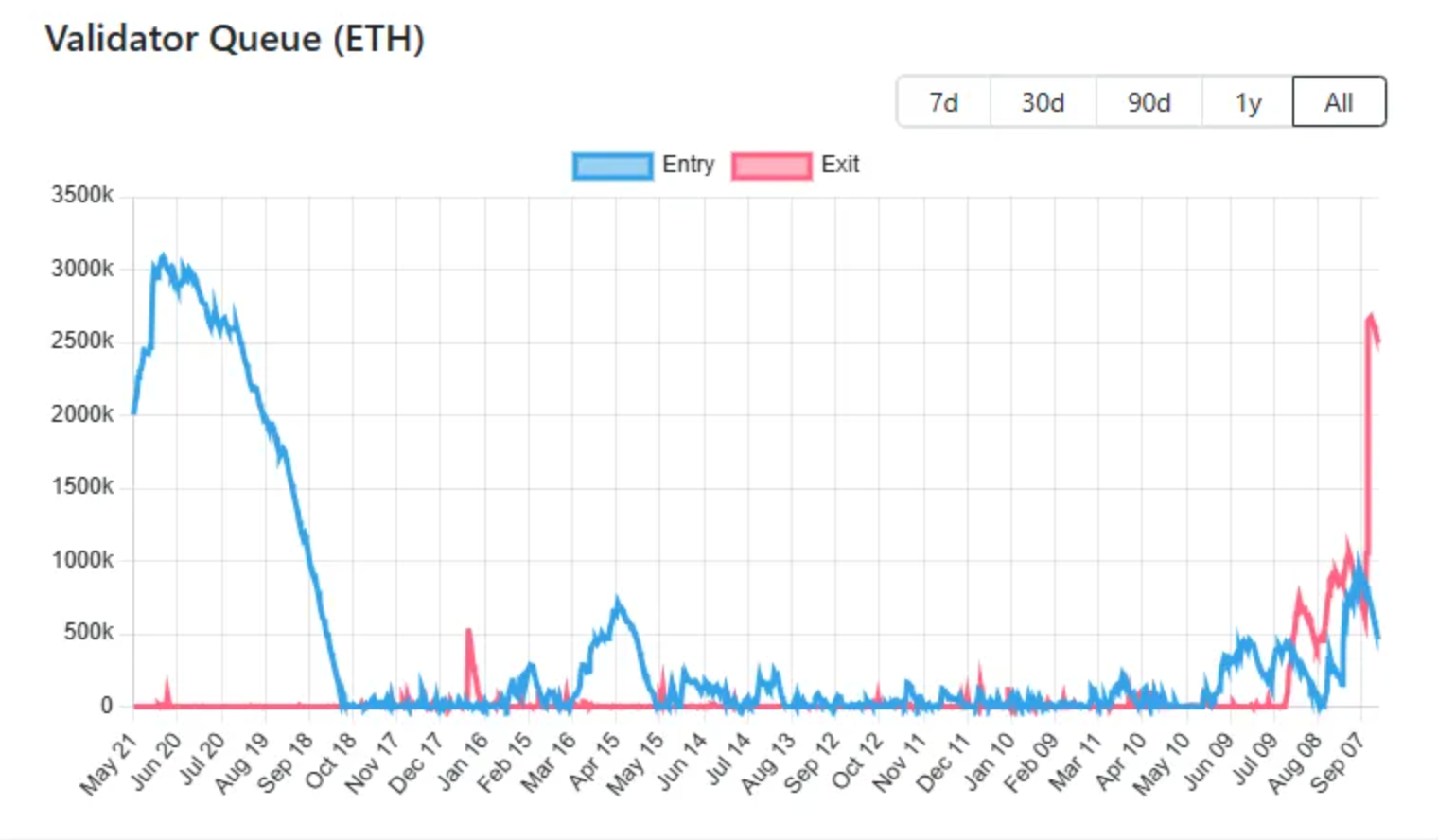
In early October, the Ethereum ecosystem experienced its largest surge in unstaking requests over the past year. The volume of coins waiting in the exit queue reached 786,000 ETH (approximately $1.8 billion at current exchange rates), representing around 2% of total capital locked in the network. Due to strict protocol limits, the wait time for validators to fully unlock their funds has climbed past 13 days.
Two-Sided Throughput Crisis
The situation is compounded by the fact that the record exit congestion is unfolding alongside equally high demand for entry. Nearly 1.5 million ETH has accumulated in the activation queue, pushing the waiting period to launch new nodes to almost a month—approximately 25 days.
Delays on both sides are not a network failure, but rather the intended functioning of Ethereum’s security mechanisms. The rate at which the validator set updates is restricted by a parameter known as the churn limit. Designed to safeguard consensus, this mechanism prevents instantaneous entries and exits that could leave the network vulnerable to 33% or 51% attacks, or dilute the Proof-of-Stake security model.
Under current parameters, the algorithm’s throughput is fixed: the blockchain can process no more than 57,600 ETH per day entering the system, and an identical amount exiting it. When multiple major triggers overlap, this throttling mechanism inevitably leads to multi-day bottlenecks.
MetaMask Incident as the Primary Trigger
The primary catalyst behind the current market surge was a technical incident affecting the infrastructure of MetaMask, the popular Web3 wallet developed by Consensys. The company reported taking precautionary measures to shut down a portion of its nodes due to disruptions at an external infrastructure provider.
According to estimates by independent security researcher Kaden, the preventive withdrawal affected roughly 17,000 validators holding approximately 523,000 ETH. While representatives from MetaMask and Consensys have not officially confirmed these figures, the scale of the exit queue indirectly points to a major risk-mitigation operation.
Hosting Bottlenecks: Centralization Risks in PoS Ecosystems
The events in Ethereum have once again highlighted the pressing issue of physical infrastructure centralization in decentralized networks. Although the protocol itself is built to withstand individual node failures, validators remain heavily concentrated across a small cluster of cloud providers and data centers.
A similar vulnerability emerged on August 12 in the Solana network. Due to a routing failure at major provider TeraSwitch, validators representing 28.83% of all staked SOL simultaneously went offline. The sudden loss of nearly a third of the network’s staking weight brought block production dangerously close to a halt.
Outlook and Implications for Market Participants
For retail investors and institutional players alike, these bottlenecks mean a temporary loss of liquidity and operational flexibility:
- Liquidity Freeze: Investors deciding to exit staking right now must account for at least a two-week wait before gaining access to their assets.
- Capital Inefficiency: For those looking to activate new nodes, the non-earning waiting period has expanded to roughly 25 days.
- Service Risk Re-evaluation: This event is expected to prompt a review of service level agreements (SLAs) with staking infrastructure providers and accelerate adoption of multi-provider setups.
Over the long term, however, strict churn limits prove their worth: even amid a sudden surge or preventive offloading of hundreds of thousands of ETH, the Ethereum network maintains operational stability, preventing cascading failures and protecting consensus integrity.