For a long time, the prevailing belief was that decentralized exchanges (DEXs) were destined to remain in the shadow of centralized giants (CEXs) due to liquidity constraints and latency issues. However, Hyperliquid is proving the exact opposite. The vector of the industry is shifting: perp-DEXs are not just taking market share from traditional exchanges—they are beginning to dictate the rules of the game.
1. Digital Expansion: Aggressively Capturing CEX and Binance Volumes
Hyperliquid’s May performance forced analysts to completely rewrite their forecasts. The platform’s share of the total volume of perpetual futures trading across all centralized exchanges reached a record 6.63%.
To understand the true scale of this figure, one only needs to look at the market’s overarching architecture:
- Global CEX Derivatives Turnover: $3 trillion.
- Hyperliquid’s Volume: $200 billion (during the May surge).
- Comparison to the Leader: Relative to the trading volume of the industry leader, Binance, Hyperliquid’s share stood at a staggering 14.4%.
Crucially, this was not a temporary spike driven by speculative hype. The platform’s expansion continued into June, with its market share firmly consolidating around the ~7.5% mark. The protocol is systematically migrating institutional traders and market makers who prioritize the transparency of on-chain settlements.
2. The HIP-3 Mechanism: Transforming an Exchange into an Infrastructure Hub
The primary driver of this exponential growth was the launch of the HIP-3 upgrade. This move effectively transformed Hyperliquid from a simple trading protocol into a global ecosystem and a foundational layer for other DeFi projects.
The core of the mechanism allows third-party development teams to deploy their own perpetual contract markets, complete with independent order books and isolated margin systems.
HIP-3 Economics for Developers:
- Barrier to Entry: Staking 500,000 HYPE to launch a single market. This creates massive deflationary pressure on the token by removing significant volume from circulating supply.
- Incentive: Developers receive a fixed 50% of all trading fees generated on their custom market.
The strategy paid off immediately: in May alone, the trading volume within the HIP-3 segment surpassed $62 billion, pushing Hyperliquid’s total 30-day derivatives volume to a staggering $176.97 billion.
3. Total Dominance in Open Interest (OI)
Perhaps the most accurate health indicator for any derivatives platform is Open Interest—the total value of all outstanding derivative contracts that have not been settled or closed.
On Hyperliquid, this figure is valued at $9.82 billion.
Open Interest (OI) Distribution in the perp-DEX Segment:
┌───────────────────────────────────────┬───────────────────────────────────────┐
│ Hyperliquid: 54% ($9.82B)             │ All other protocols combined: 46%     │
└───────────────────────────────────────┴───────────────────────────────────────┘
Controlling 54% of the entire perp-DEX market means Hyperliquid commands more liquidity than all of its decentralized competitors combined. For large institutional players, this is the ultimate selling point: it allows them to enter multi-million dollar positions without the risk of experiencing severe price slippage.
4. The Synthetic Revolution: Merging TradFi and Venture Capital
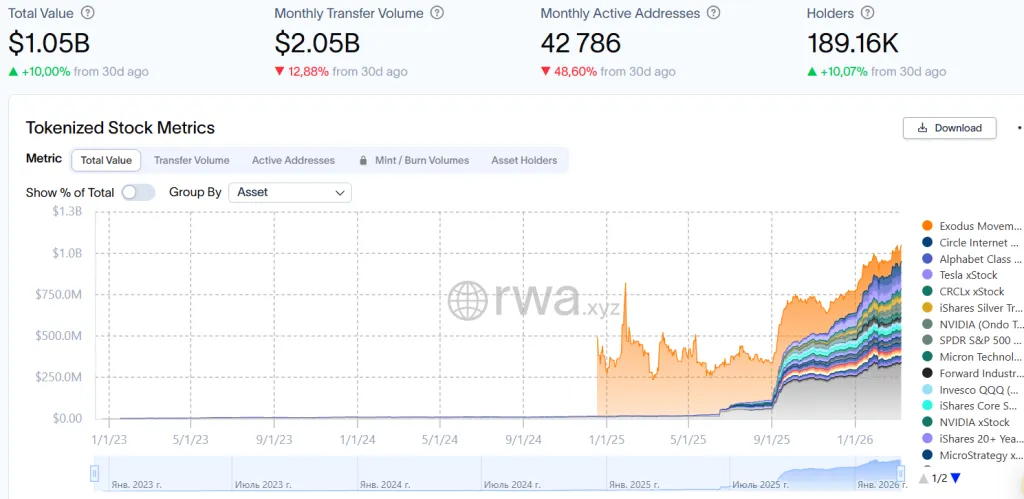
Hyperliquid is shattering the stereotype that crypto exchanges are only meant for trading native tokens. The platform’s success is heavily supported by its aggressive integration of synthetic assets. Traders now have seamless access to markets that previously required complex verification processes or accredited investor status:
- Traditional Stock Market: Tokenized contracts on shares of tech leaders (Tesla, Apple, Nvidia);
- Commodities Markets: Traditional commodities (Gold, Oil, etc.);
- Venture Capital Segment (Pre-IPO): Evaluation contracts on the valuation of major private companies, including OpenAI and SpaceX. This allows retail investors to speculate on the success of the world’s top tech startups long before their official public listing.
5. The HYPE Token: A Massive Rally and a Duel with Solana
The protocol’s fundamental achievements were instantly mirrored in the price of its native token. On June 2, HYPE established a new all-time high (ATH) at $75.48. The price is currently consolidating around $65.15, locking in the project’s market capitalization at a massive $14.46 billion.
The crypto community is actively discussing HYPE’s psychological duel with Solana (SOL). In terms of nominal asset price, Hyperliquid is practically neck-and-neck with the Layer-1 giant:
- HYPE: ~$65.15
- SOL: ~$68.64
Nevertheless, talking about a full “flippening” is premature. In terms of total market capitalization, Solana ($39.23 billion) still heavily outpaces Hyperliquid. However, the mere fact that such price parity exists highlights the immense trust investors place in HYPE’s tokenomics.
6. Wall Street and Regulatory Reaction: From Praise to Concern
Hyperliquid’s meteoric rise has become too massive for traditional financial institutions to ignore. The reaction has been two-fold—ranging from admiration to clear anxiety over the preservation of the status quo.
On one side, analysts at Grayscale Research (one of the largest crypto institutional players) officially labeled the platform the biggest recent breakthrough in the DeFi sector, praising its technological superiority and its ability to retain liquidity.