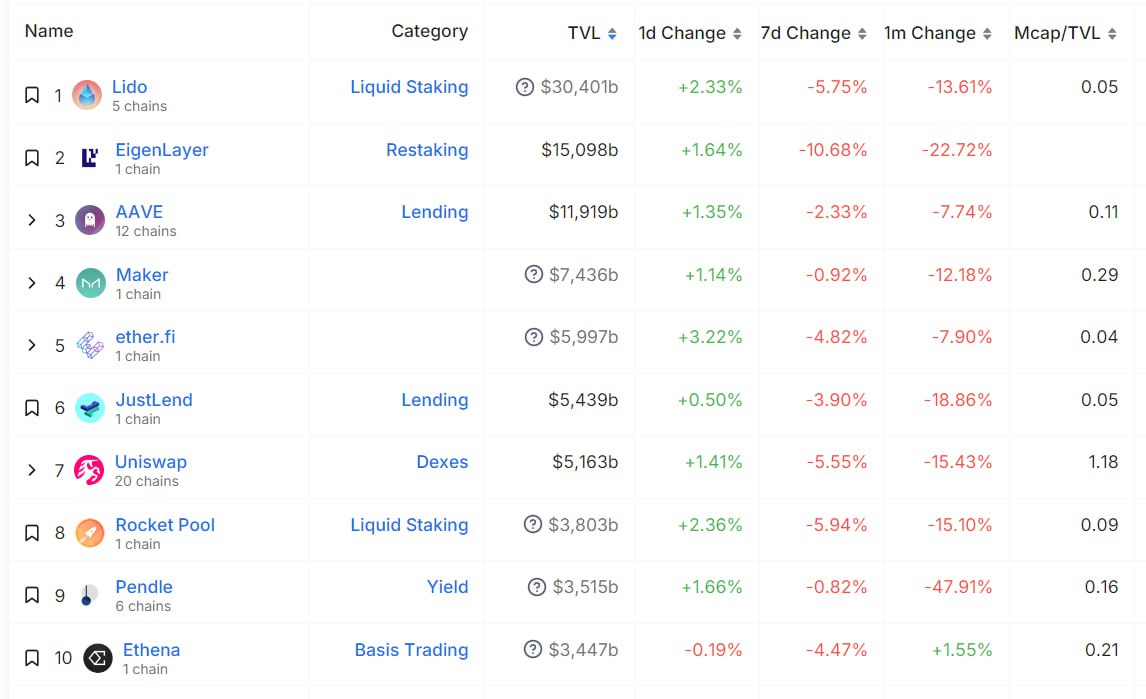
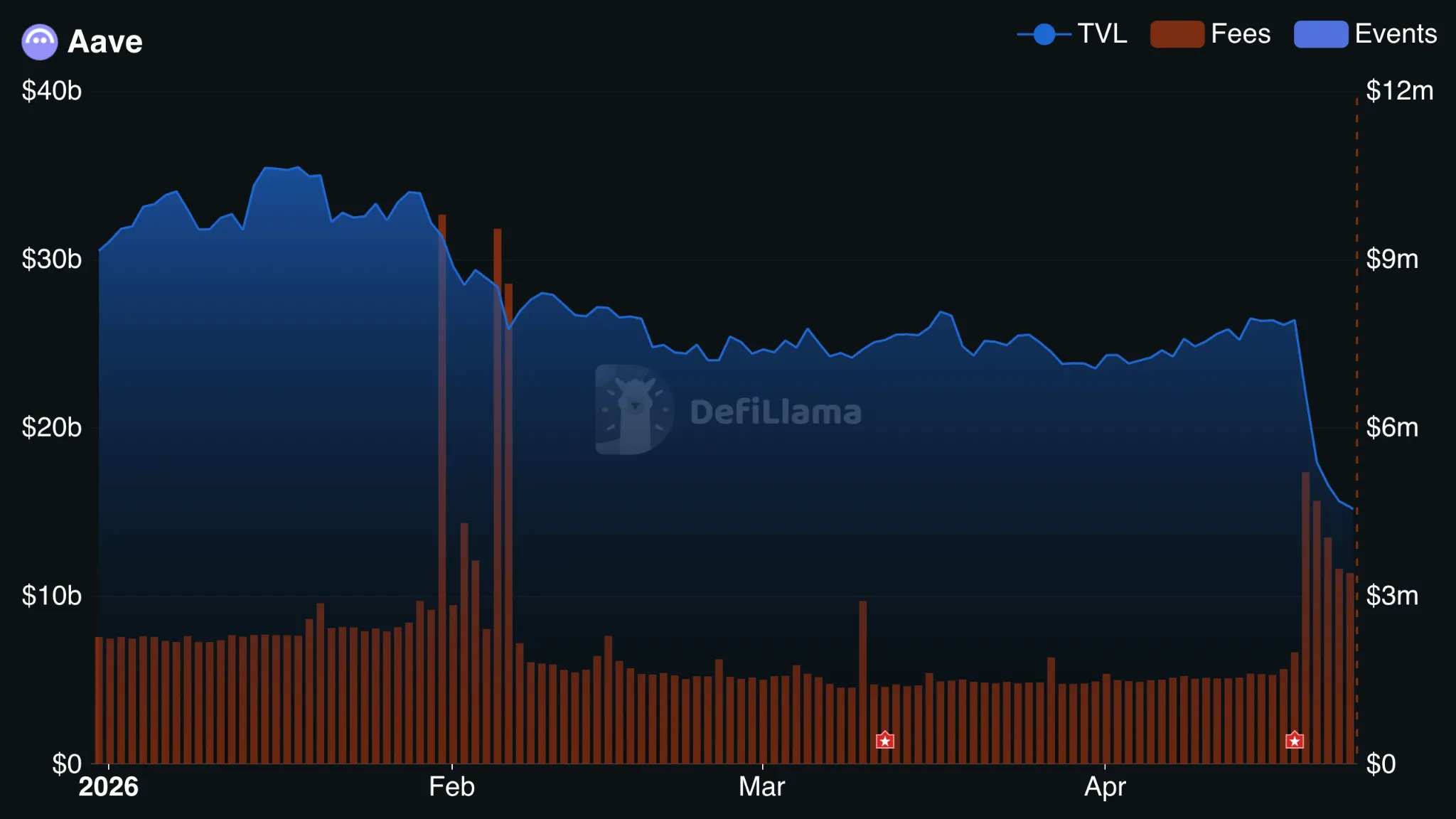
Aave, the industry’s leading lending protocol, is facing unprecedented pressure. In just a matter of days, total deposits within the ecosystem plummeted by 35%, dropping from a record $45.8 billion to $29.6 billion. As of now, the decline continues: the Total Value Locked (TVL) is hovering around $15.1 billion, nearly half of its value from just a week ago.
The Kelp Hack Echo and Hacker Maneuvers
The trigger for this massive capital exodus was an incident involving the Kelp protocol. According to on-chain analyst EmberCN, the hacker behind the attack has moved into an active phase of laundering the stolen funds.
- Scale: The attacker siphoned off 75,700 ETH (approximately $175 million).
- Method: Almost the entire volume of assets was converted into Bitcoin via the decentralized THORChain network.
- Market Impact: The hacker’s anomalous activity pushed THORChain’s trading volume above $800 million, generating roughly $910,000 in fee revenue for the platform in a few days.
Amidst this general uncertainty, the native AAVE token is showing a downward trend, losing 13.8% of its value over the past week. The asset is currently trading around $91.4.
Emergency Measures: Fluid’s Lifeline
To prevent a total liquidity paralysis, the Fluid project launched a redemption mechanism for aWETH (Aave’s interest-bearing wrapped Ether). This solution allowed users, whose funds were effectively “locked” due to high pool utilization, to exit into more liquid assets like wstETH or weETH.
Results of the mechanism after 48 hours:
- Processed 166,772 aETH (roughly $400 million).
- Redemptions were carried out at a discount of approximately 2.2%. This was a lifeline for investors, considering that the discount on “frozen” Ether had reached a catastrophic 23% on the secondary market.
The USDC Pool Crisis: Circle’s Radical Proposal
The situation is further complicated by a critical shortage of stablecoins. The USDC pool on Aave v3 has remained at maximum capacity for four consecutive days. Available liquidity has dropped below $3 million, and loan demand persists even with the current borrowing rate capped at 14%.
Circle’s Chief Economist, Gordon Liao, proposed an aggressive strategy to save the pool by radically increasing interest rates:
- At 95% pool utilization — raise the rate to 37%.
- At 100% utilization — set the rate at 53%.
Liao’s Logic: “The current 14% rate isn’t deterring borrowers who want to exit positions at any cost following the Kelp hack. A progressive rate will force debtors to repay and attract new liquidity providers seeking ultra-high yields.”
Community Reaction
The proposal met sharp criticism. Opponents, including Avant protocol founder Rhett Shipp, believe that in a systemic crisis of confidence, simply raising rates will not stop the capital outflow. In their view, such measures might only trigger a wave of forced liquidations and further destabilize the protocol.
Currently, Aave remains in a zone of high turbulence. The market’s attention is fixed on whether the platform can restore its liquidity balance without resorting to “prohibitive” tariff hikes.