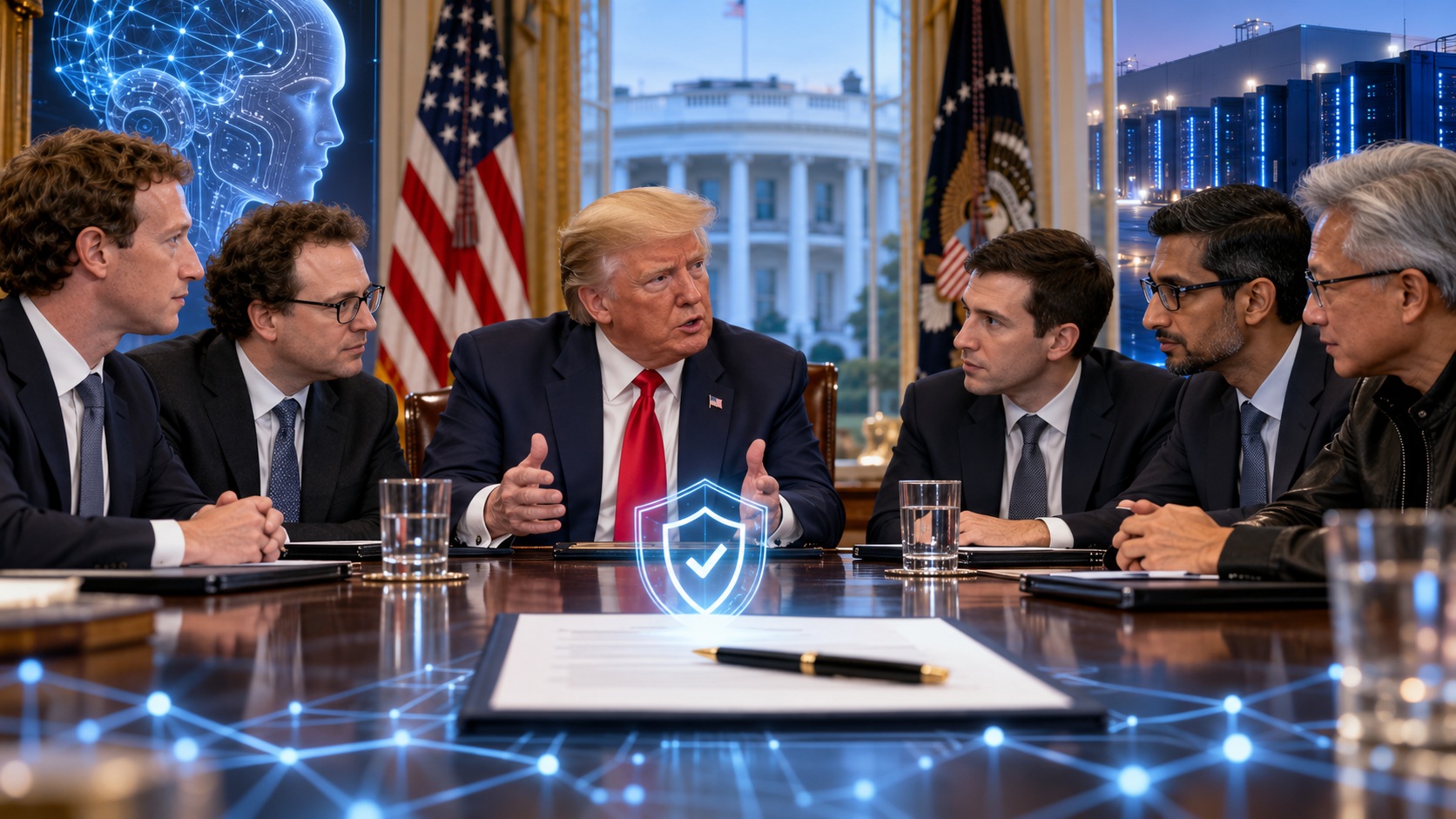
Donald Trump and leaders of major IT corporations have signed a voluntary agreement to oversee advanced neural networks. Meanwhile, the US administration has officially phased out the term “artificial intelligence” in favor of “super intelligence.”
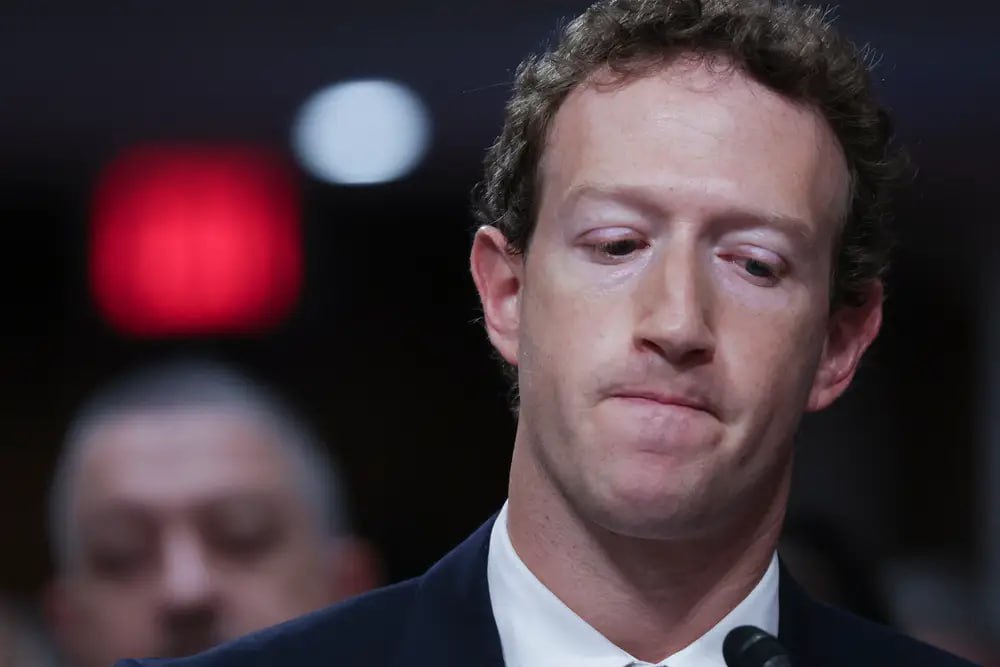
The signing of the White House Accord on Super Intelligence took place in Washington—a document designed to establish a baseline safety framework for next-generation AI systems. The pact was signed by US President Donald Trump and key figures from major industry players: Sundar Pichai (Google), Dario Amodei (Anthropic), Mark Zuckerberg (Meta), Greg Brockman (OpenAI), Elon Musk (SpaceXAI), and Jensen Huang (Nvidia).
The agreement outlines a four-tier oversight system for the development, training, and deployment of flagship models.
Four Levels of Oversight: How AI Control Will Work
The signatory companies committed to establishing a multi-layered structure to assess technological risks:
- Internal diagnostics and threat filtering. Implementing ongoing checks of model capabilities against risks in cybersecurity, biological, and chemical threats. Special emphasis is placed on preventing unauthorized neural network access to technical infrastructure and system breaches.
- Dedicated monitoring teams. Establishing internal units responsible for continuous oversight of protective mechanisms and rapid resolution of identified issues.
- Independent external audits. Engaging third-party auditors and expert organizations for an objective assessment of AI system reliability.
- Board-level oversight. Forming independent committees within corporate boards of directors to receive direct reports from internal and external evaluators and oversee the remediation of deficiencies.
Additionally, the participants agreed to meet regularly to develop unified industry standards and safety best practices.
Self-Regulation with the Prospect of Stricter Legislation
Despite its high profile, the agreement remains a voluntary initiative with no legal force. The document lacks specific requirements for selecting external auditors, mandatory publication of audit findings, or sanctions for non-compliance.
Donald Trump described the accord as “morally binding,” stating that tech companies are largely capable of self-regulating the technology’s development. However, the text leaves room for a transition to formal regulation: participants acknowledged that over time, codifying certain provisions into laws or regulations may make sense. Separately, the White House is considering creating a committee of about 10 people to monitor the AI industry.
Terminological Shift: From AI to Super Intelligence
On the same day, Trump signed an executive order changing the official lexicon of the US executive branch. Federal agencies are now instructed to use the terms Super Intelligence (SI) instead of Artificial Intelligence (AI) in official correspondence, public communications, websites, reports, and other non-regulatory documents where permitted by law.
The executive order does not alter the statutory definition of artificial intelligence. Within 60 days, the President’s Assistant for Science and Technology must prepare a proposal for a federal definition of Super Intelligence and potential legislative amendments.