Short answer: Binance has no direct “withdraw to M-Pesa” button. To get Kenyan shillings on M-Pesa, you sell your crypto (usually USDT) for KES on Binance P2P to another user, who pays you through M-Pesa. Binance holds your USDT in escrow until you confirm the money has arrived. The process usually takes 5–30 minutes. Before you start, read the safety rules and the 2026 regulatory notes below: they matter more than the buttons.
Checked and updated: October 2026
Before you start
- Verified Binance account. P2P requires completed identity verification (KYC).
- M-Pesa in your own name. Binance P2P rules require the payment account to match the verified name on your Binance account. Payments from third parties are not allowed.
- Know the M-Pesa limits. For personal accounts, Safaricom’s limits are KSh 250,000 per transaction, KSh 500,000 per day and a maximum balance of KSh 500,000. Larger amounts have to be split over several days.
- Have your crypto as USDT. USDT is the most liquid P2P pair for KES. If you hold BTC or another coin, convert it to USDT first. If you are new to USDT, read What Is USDT?.
- Turn on 2FA (authenticator app or passkey). You need it to release crypto.
Step-by-step: sell USDT for KES on Binance P2P
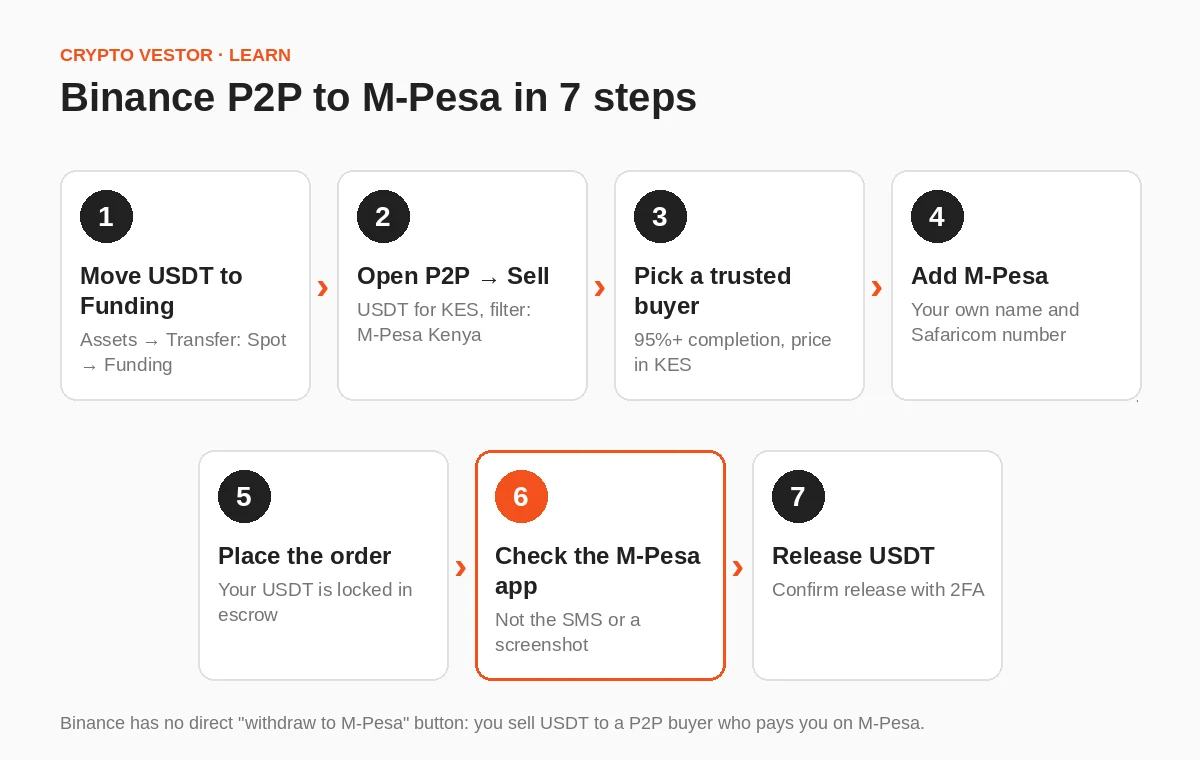
Step 1. Move USDT to your Funding account
P2P orders use your Funding wallet, not your Spot wallet. In the app, go to Assets → Transfer, choose Spot → Funding and move the USDT you want to sell.
Step 2. Open P2P and choose “Sell”
Go to Trade → P2P, tap Sell, choose USDT as the crypto and KES as the currency. Filter the payment method to M-Pesa Kenya (Safaricom).
Step 3. Choose a buyer carefully
Don’t just pick the top price. Check:
- completion rate (preferably 95%+) and number of completed orders;
- verified merchant badge, if available;
- order limits that fit your amount;
- that the price is in KES. Ads quoting USD are a known way to trick sellers into accepting less.
Step 4. Add M-Pesa as a payment method
If you haven’t added it yet, the app asks you to: enter your full name exactly as on your Binance account and your Safaricom phone number.
Step 5. Enter the amount and place the order
Type the amount in USDT or KES, check the total you will receive, then tap Sell USDT. Your USDT is locked in escrow, and the buyer sees your M-Pesa details.
Step 6. Wait for the payment and check it inside M-Pesa
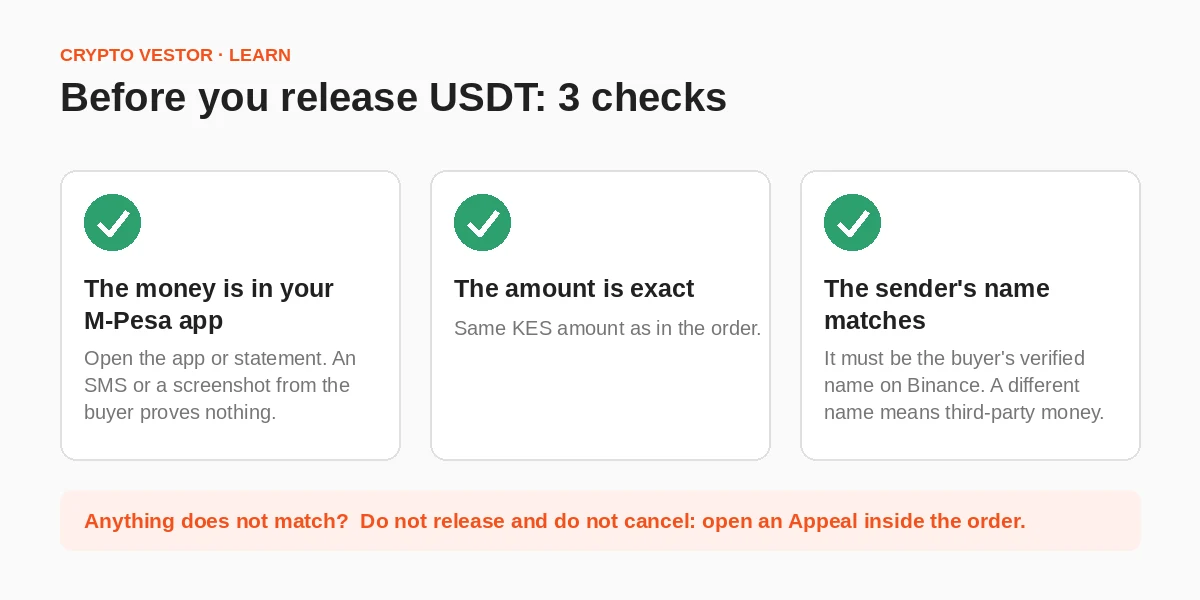
When the buyer marks the order as paid, do not trust the screenshot or SMS they send. Open the M-Pesa app (or your M-Pesa statement) and confirm that:
- the money has really arrived;
- the amount is exact;
- the sender’s name matches the buyer’s verified name on Binance.
Step 7. Release the USDT
Only when all three checks pass, tap Confirm release and verify with 2FA. Under Binance’s rules, once you have confirmed the payment you are expected to release within 15 minutes. The order is then complete.
“Express” mode. Binance also offers P2P Express, which matches you with an order automatically. It is quicker but gives you less control over who the buyer is, and a small taker fee may apply. Fee rules change, so always read the fee shown before you confirm.
How much does it cost?
- Binance P2P: placing an order on someone else’s ad is often free for you as a seller. Binance has charged maker or taker fees of around 0.1–0.2% in some KES cases. Check the fee line in the order before confirming.
- M-Pesa: receiving money on M-Pesa is free. The fees are paid when you later withdraw cash or send money on.
- The real “cost” is the price. Compare the P2P KES price with the market rate. You can check the current market rate with our USDT price tool.
Scams to watch out for
P2P fraud in Kenya usually follows a few patterns:
- Fake M-Pesa messages. The scammer sends an SMS that looks like an M-Pesa confirmation, or a screenshot. Only the M-Pesa app or statement counts.
- Payment from a different name (third-party or “triangle” fraud). Someone else’s money, often stolen, is sent to you. If you release, your account can be frozen and you may have to refund. If the name doesn’t match, don’t release: refund and open an appeal.
- Reversal requests. After you release, the buyer asks Safaricom to reverse the payment. Keep records of every order and the M-Pesa reference.
- Pressure and chat tricks. “Please release fast, my boss is waiting”, “I’ll pay the rest later”, “let’s continue on WhatsApp”. Never move the deal outside Binance and never release early.
- Fake support. Binance support will never ask for your password, 2FA codes or seed phrase, or ask you to release an order.
If something goes wrong: don’t cancel the order yourself and don’t release. Use Appeal inside the order and upload your M-Pesa statement. Binance’s appeal rules generally protect sellers who did not release before receiving the payment.
Is it legal in Kenya? What changed in 2025–2026
- The VASP Act 2025 took effect on 4 November 2025. It makes the Central Bank of Kenya (CBK) and the Capital Markets Authority (CMA) the licensing authorities for crypto service providers. In a November 2025 public notice, the CBK said no provider had yet been licensed. The implementing VASP Regulations were published in July 2026, and existing operators have a transition period to apply.
- April 2026 account freezes. Kenya’s Directorate of Criminal Investigations (DCI) had an undisclosed number of Binance user accounts frozen as part of a crackdown on fraud and money laundering. Some users reported funds stuck in P2P trades. This is the biggest practical risk for P2P users: if you trade with a buyer whose money is dirty, your account can be frozen too.
- Tax. The 3% Digital Asset Tax was repealed by the Finance Act 2025 (from 1 July 2025). It was replaced by a 10% excise duty on the fees that platforms charge. Ordinary income-tax rules may still apply to your gains; check with KRA or a tax adviser.
Rules are changing quickly. Before large transactions, check whether your platform has been licensed under the VASP Act.
Alternatives to Binance
- Other exchanges’ P2P (for example, Bybit P2P, which runs campaigns for Kenyan users). The same safety rules apply.
- Local providers: some well-known names have changed their models. Yellow Card, for example, closed its retail app in late 2025 to focus on business clients. Always check that the service is currently available to individuals in Kenya.
Frequently asked questions
Can I withdraw directly from Binance to M-Pesa?
No. As of October 2026 there is no official direct “withdraw to M-Pesa” option in Binance. The standard way is to sell USDT for KES on Binance P2P and get paid on M-Pesa.
How long does a Binance to M-Pesa withdrawal take?
Usually 5–30 minutes, depending on how quickly the buyer pays. If the buyer doesn’t pay within the order time, the order is cancelled and your USDT returns to your Funding wallet.
What is the maximum I can withdraw to M-Pesa?
The limit comes from M-Pesa, not Binance: KSh 250,000 per transaction and KSh 500,000 per day for personal accounts. Above that, use several orders over several days, or a bank transfer method if the buyer offers one.
Why was my Binance account frozen in Kenya?
In April 2026, the DCI had a number of Binance accounts frozen in an anti-money-laundering crackdown. Accounts are also frozen when stolen or third-party money passes through P2P orders. Contact Binance support through the app only, and keep your M-Pesa records.
Is there tax on crypto in Kenya in 2026?
The 3% Digital Asset Tax no longer applies (repealed in July 2025). Platforms pay a 10% excise duty on their fees. Gains may still be taxable as income, so check with KRA.
This guide is for information only and is not financial advice. Crypto is high-risk and P2P trading carries counterparty risk. Read our Disclaimer.