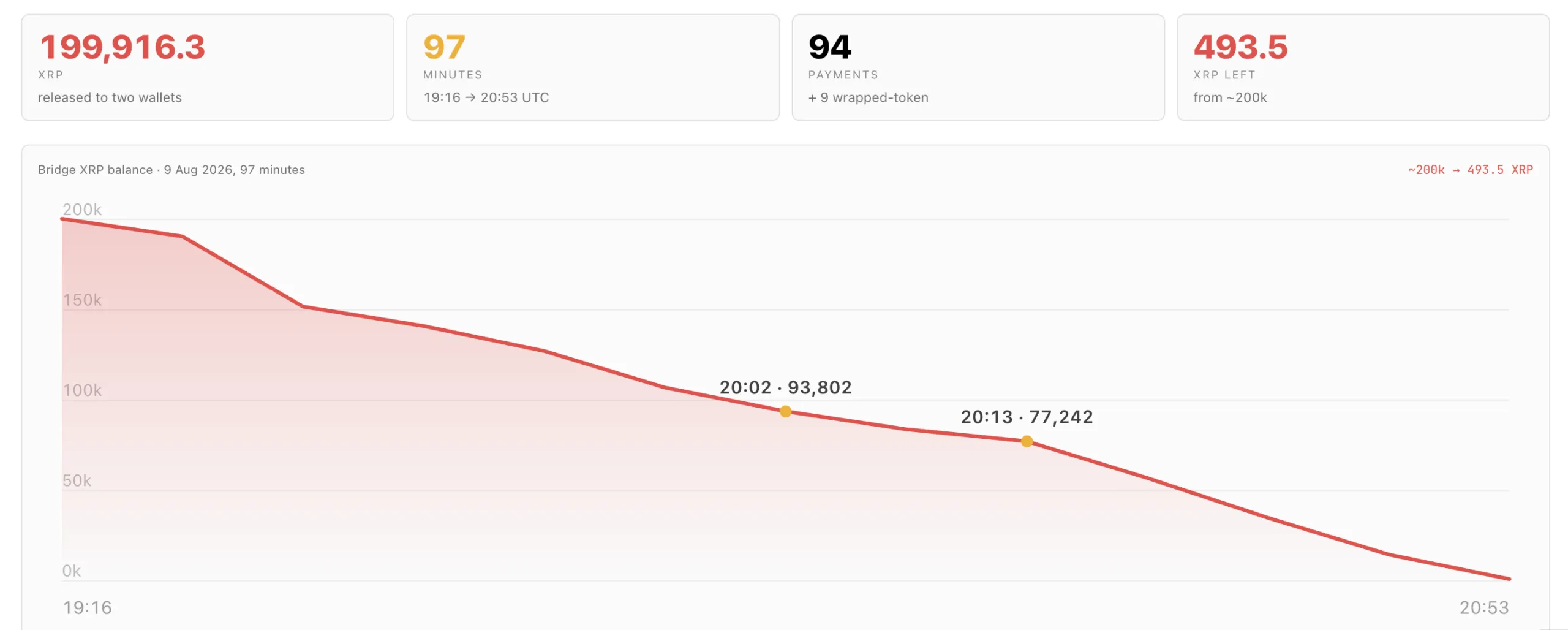
Recent security incidents have been recorded in the blockchain space, targeting key infrastructure solutions: the tx cross-chain bridge connecting to the XRP Ledger, and the Layer-1 project Harmony. In one case, an attacker exploited smart contract logic, while in the other, an unprecedented unauthorized token mint occurred.
The tx Cross-Chain Bridge Hack: $200,000 Lost to a Logic Error
On August 9, an attacker drained the reserve wallet of the bridge connecting the XRP Ledger with the tx ecosystem, netting nearly $200,000.
How the Attack Worked
The attack was made possible by a vulnerability in how incoming deposits were processed:
- The bridge mistakenly recorded transactions with a zero XRP balance as valid deposits.
- Based on these fake records, the system minted “wrapped” tokens on the tx network.
- The hacker then exchanged these wrapped tokens for real XRP coins stored in the vault.
According to the analytics platform xrpl.to, the siphon process took just 97 minutes. During this window, the attacker executed 94 transactions to two new wallets. As a result, only 493.5 XRP remained on the bridge balance, down from an initial ~200,410 XRP.
Technical Detail: Each of the 94 transactions was confirmed by 17 out of 28 relayer keys—the exact threshold required by the system’s consensus rules.
Consequences and Team Response
- Network Security: Private keys were not compromised, and the XRP Ledger itself operated without interruption. User funds on centralized and decentralized exchanges (CEX/DEX), as well as on the mainnet, were unaffected.
- Immediate Action: The tx development team temporarily halted bridge operations, patched the vulnerable code, and engaged external security experts.
- Investigation: All transaction data has been submitted to the FBI’s Internet Crime Complaint Center (IC3). The team is currently assessing reimbursement options for affected users.
The Harmony Attack: 4 Billion Tokens Minted and a 30% Price Drop
Concurrently with the XRP bridge incident, the Layer-1 blockchain Harmony suffered an attack.
Compromised:            4 billion ONE (~26% of total supply)
Transferred to CEXs:    2.8 billion ONE
Price Drop:             ~30%
Details of the Hack
According to an analyst known as Juiceberg, the attacker exploited a vulnerability related to empty block generation. This allowed them to mint 4 billion ONE tokens out of thin air—representing over a quarter of the total token supply. The hacker immediately transferred 2.8 billion ONE to trading venues for liquidation.
Following news of the unauthorized minting, ONE’s market price plunged by nearly 30%.
Developer Response
The Harmony team stated they are actively collaborating with centralized exchanges to freeze and lock the transferred assets. As a potential remedy, developers are considering a full network rollback to a state prior to the attack.
A Repeat Blow to Reputation
This is far from the first major incident for Harmony:
- June 2022: The project lost $100 million following a multi-sig wallet compromise (according to CertiK).
- Attribution: Elliptic analysts and FBI investigators later confirmed that the North Korean hacking group (Lazarus Group) was behind that breach.
Key Takeaways
Both cases clearly demonstrate that major risk vectors in the industry remain not only cross-chain bridges, but also the underlying block validation logic in Layer-1 networks. Rigorous deposit logic verification and strict minting limits remain fundamental security requirements.