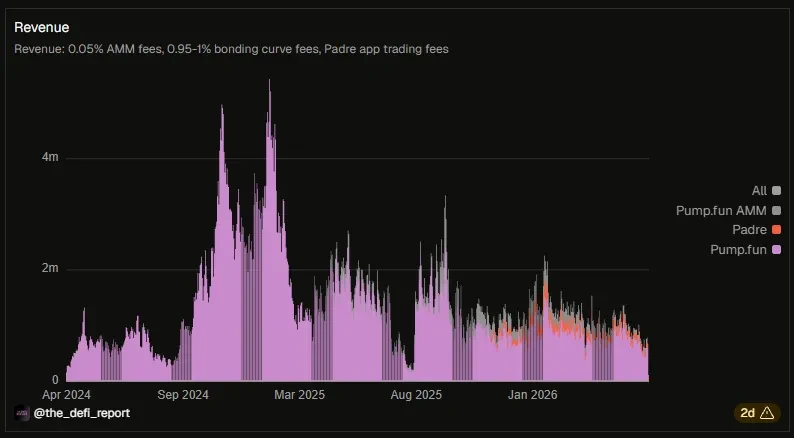
It seems the prolonged memecoin fever is finally starting to cool down. Pump.fun, the wildly popular platform that became the ultimate assembly line for express-creating joke crypto assets, is going through tough times. Since August, the protocol’s key metrics—from new token launches to trading fee volumes—have been locked in a steady downward spiral.
The Numbers Don’t Lie: A Nosedive for Key Metrics
Statistics from the Dune analytical dashboard clearly confirm that retail investors’ appetite for ultra-risky assets is fading fast.
- Bonding Curve Crash: In June, the share of tokens that successfully completed their initial liquidity pooling and graduated to decentralized exchanges dropped to a critical 0.16%. For comparison, at the March peak, this metric exceeded 2%.
- Production Slump: The daily number of coins generated on the platform has decreased by 30% compared to the highs seen in the spring.
- Revenue Collapse: The platform’s daily revenue plummeted to $800,000, down from the steady $2 million per day the site was pulling in back in January.
- Drying Liquidity: Daily trading volumes nosedived from $400 million at the beginning of the year to the current $100 million. Naturally, token creators’ earnings fell right along with the turnover.
Native Token PUMP Hits Rock Bottom
The ecosystem’s troubles have directly hit its own financial health. The platform’s native token—PUMP—has been in a deep knockout for quite some time. The asset has lost around 80% of its value from its all-time highs, which were recorded almost immediately after its high-profile launch in September 2025.
Where Are Traders and Liquidity Going?
What is happening to Pump.fun is not a localized failure, but a predictable symptom of the entire segment cooling off. Over the past 30 days alone, the aggregate market capitalization of the memecoin sector has shrunk by nearly $8 billion.
The reason for the trend shift is simple: retail capital has found a new “toy.” There is a mass exodus of speculators into the perpetual futures (perpetuals) sector.
Platforms like Hyperliquid have managed to offer users the same easy, gamified access to trading as Pump.fun, but with one crucial difference: they deal with much more predictable and liquid assets. On these platforms, the chances of losing everything in the first second due to a blatant rug pull are significantly lower.