Modern financial markets are increasingly becoming an arena where traditional stock trading, decentralized finance (DeFi), and generative artificial intelligence intersect. On September 2, this volatile mix sparked unprecedented volatility: shares of Farmmi (FAMI), a modest Chinese agricultural supplier, suddenly surged by over 300%. The catalyst was not a breakthrough financial report, but an AI-generated social media post and the ensuing speculative mania surrounding meme coins.
Anatomy of a Market Anomaly
On Monday, September 2, trading of Farmmi shares on the Nasdaq exchange began with a shocking spike. Shares of the company, which had been in a prolonged slump, skyrocketed from $0.1187 (the previous close) to a high of $0.50.
The sheer scale of the frenzy is best illustrated by trading volume: while a typical day saw roughly 5.76 million shares change hands, daily volume during the pump soared to an astronomical 867.2 million shares. By the end of the session, gravity took hold, and most of the gains evaporated—the closing price landed at $0.1501. Nonetheless, the day’s gain still stood at an impressive 26.45%.
The “Ideal Plan” Written by an AI
The catalyst behind this frenzy was a post on X (formerly Twitter) by a crypto trader operating under the pseudonym Rune. Rune shared a grand investment scheme with his followers.
He claimed to have spent roughly $1.8 million to acquire a 37.4% stake in an unnamed Nasdaq-listed company. The post provided specific details: the firm had a market capitalization of around $4.8 million and a stock price near $0.12.
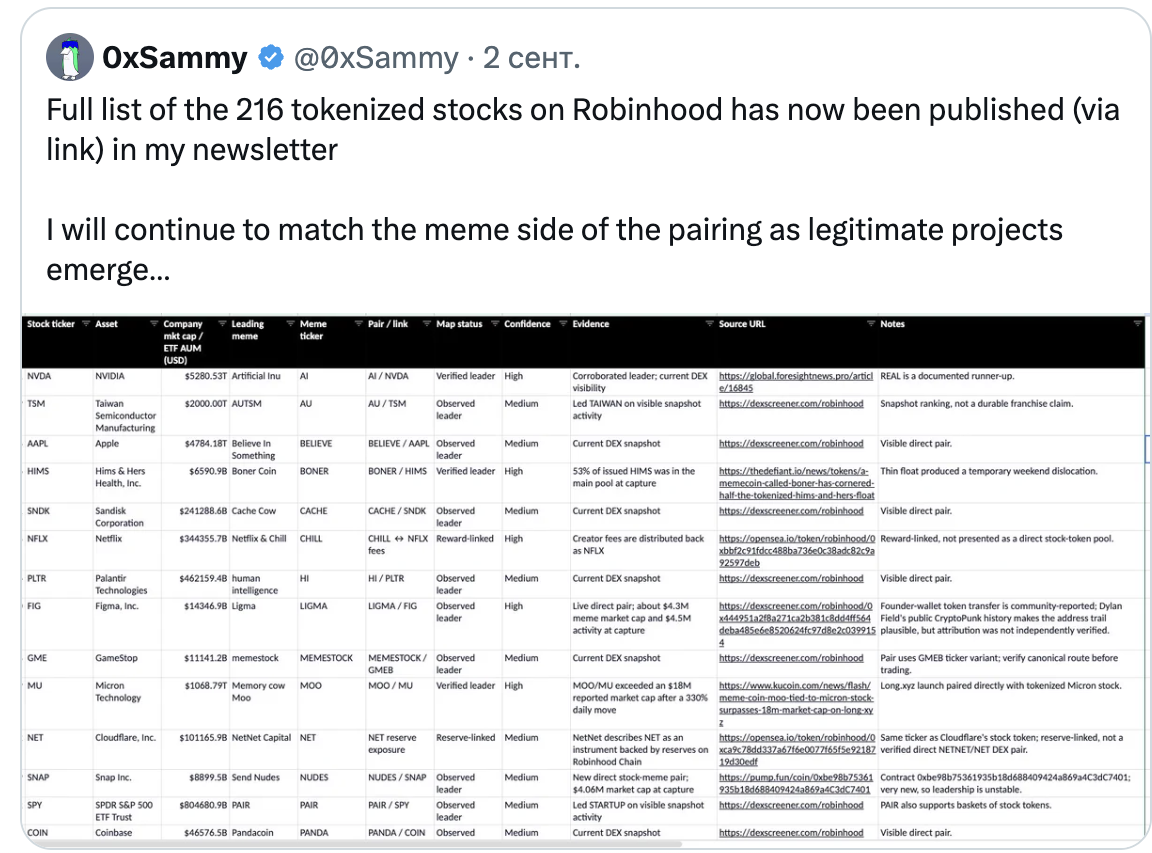
Rune then outlined a clever playbook: he planned to tokenize the acquired shares on the Robinhood Chain and launch a related meme coin. The anticipated demand for the on-chain asset was supposed to trigger aggressive buying of the underlying stock on traditional exchanges, potentially triggering a massive short squeeze.
The crypto community immediately jumped in. Matching the numbers from the post (a $0.12 stock price and micro-cap status), enthusiasts quickly identified the target: Farmmi.
However, at the height of the market euphoria, Rune published a retraction. It turned out he had bought no stake in the company and launched no tokens. The entire original post had been generated by the Claude AI model in response to his prompt, with all figures and parameters completely fabricated by artificial intelligence.
The Wild West on Robinhood Chain: Mushrooms and Windfalls
Despite the author’s admission that the story was fake, the speculative flywheel could not be stopped. Anonymous developers quickly deployed two assets on the Robinhood Chain: the FAMI token and the JINQIAN meme coin.
The name JINQIAN was not chosen at random. Users combed through Farmmi’s annual report and found a reference to a variety of dried shiitake mushrooms called “Jinqian,” which translates to “money mushroom.” This detail provided the perfect narrative to market the coin.
What followed was a textbook case of crypto fever:
- Explosive Growth: Just one hour after launch, JINQIAN’s market cap breached $70 million.
- Insider Windfalls: According to analytics platform Lookonchain, one savvy trader invested 8 ETH (~$19,000) into the coin and soon unloaded the position for 82.54 ETH (~$198,000), locking in roughly $179,000 in net profit within hours.
- Astronomical Volumes: As highlighted by X user StarPlatinum, trading volume in the JINQIAN/FAMI pair neared $88 million in less than three hours.
The Illusion of Tokenization and an Investor Trap
The FAMI token launched on the network cleverly mimicked an official tokenized asset (Stock Token), but was nothing of the sort. An inspection of the smart contract revealed several critical red flags:
- Mimicked Metrics: The total supply of on-chain FAMI was set at 37.43 million tokens—matching the exact number of real Farmmi shares outstanding.
- Concentrated Holdings: Upon contract deployment, 14.22 million tokens (~38% of the total supply) were immediately transferred to the creator’s wallet. This figure closely mirrored the 37.4% stake mentioned in the Claude-generated post.
- Zero Backing: The crypto FAMI token lacked any minting or redemption mechanism. Buying the coin conferred absolutely no legal rights to real Farmmi shares on Nasdaq.
- Collapse Risk: Analysts further warned the community that liquidity in the trading pair was unlocked, meaning the deployer could pull the rug at any moment.
Farmmi’s Grim Reality: Between Delisting and Losses
While internet traders were swept up in meme coin madness, Farmmi’s underlying business remained in dire straits. The trading surge was merely a short-lived anomaly on the chart of a company fighting for survival.
Prior to the spike, the supplier’s shares had long traded below the psychological $1 mark. On August 11, Nasdaq issued an official non-compliance notice to Farmmi after its stock remained below $1 for 30 consecutive business days. The company was given until February 8, 2027, to regain compliance—requiring the closing bid price to reach at least $1.00 for ten consecutive trading days.
Fundamental metrics offer little reassurance. Financial performance is deteriorating rapidly:
- Revenue for fiscal year 2025 dropped by more than half—from $64.1 million to $28 million.
- Net loss surged dramatically—from $4.6 million to $53.4 million.
In an effort to turn things around and diversify beyond mushroom and agricultural trading, Farmmi is expanding its warehousing and logistics services in the U.S. However, it remains uncertain whether these moves will rescue the underlying business, or if the company will be remembered merely as an accidental star of an AI-generated financial fairytale.