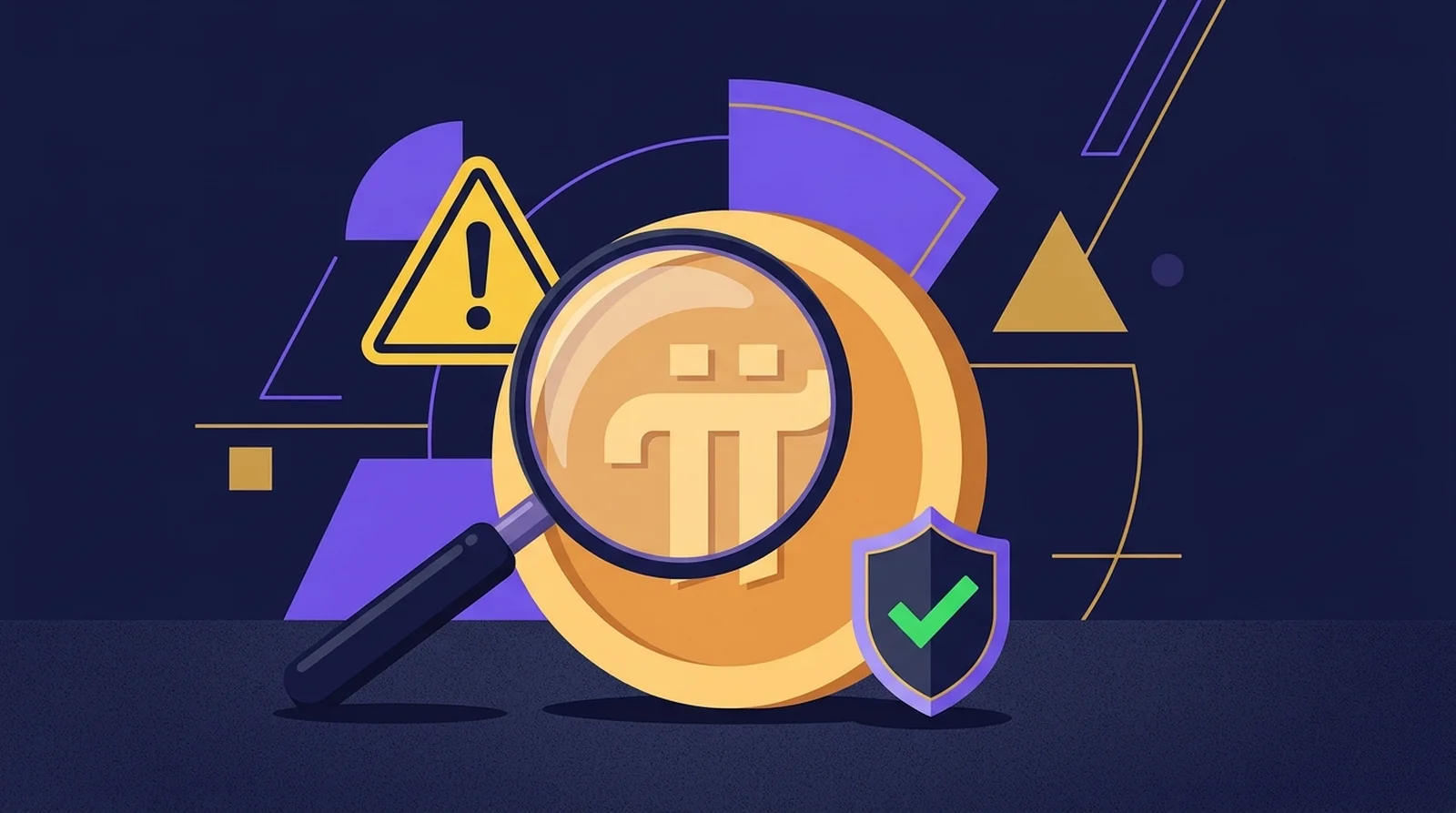
Short answer: Pi Network has a documented blockchain, an Open Network launch and confirmed exchange trading announcements. That supports calling it a real crypto project, but does not establish that every Pi offer is legitimate or that participating is risk-free.
Checked: November 2026
This guide separates the project’s documented features from claims made by sellers, promoters and supposed support agents. Our checks use official project pages, exchange announcements and public fraud warnings. Project and exchange descriptions are interested sources, not independent endorsements.
What is Pi Network, and how does the app work?
Kraken’s announcement dated March 13, 2026 describes Pi as a cryptocurrency ecosystem with its own blockchain and identifies PI as its native token. It also describes Pi Browser as an entry point to ecosystem applications.
Pi’s support page, checked November 7, 2026 with no publication date shown, describes mobile participation through mining sessions renewed every 24 hours. Its rewards system includes Security Circles, app engagement and Node operations.
A separate official FAQ says a session can continue after the mobile app is closed. It explains this through members vouching for one another, rather than the energy expenditure associated with proof-of-work mining. These are the project’s explanations of its design, not our independent measurement of phone performance.
Our reading: a balance displayed by the app should be assessed separately from coins available to transfer. Do not judge an offer from a screenshot of a rising balance. Ask which balance it shows and whether the proposed transfer can actually be made.
Is Pi coin real, and is the app balance transferable?
Pi’s support page distinguishes the mobile balance from the Mainnet wallet balance. Transferability requires identity verification, the Mainnet Checklist and migration to the blockchain. The page was checked November 7, 2026; it contains some older Enclosed Network wording.
That distinction matters when someone claims they can sell everything visible in an app. A displayed balance alone does not demonstrate that the seller controls transferable Mainnet Pi.
Pi also describes its wallet as noncustodial: the user controls the passphrase, and the wallet cannot be recovered from Pi’s servers. Treat the passphrase as access to the wallet, not as information a buyer or support agent needs.
Our reading: “is pi coin real” and “can this person deliver Pi” are separate checks. The existence of a blockchain does not verify a seller, a wallet link or a payment request.
What does Pi Network mainnet mean today?
Pi’s Open Network announcement, published February 11, 2025 and showing an update dated February 14, scheduled the transition for February 20, 2025. It explains that the earlier Enclosed Network was already Mainnet, but had a firewall preventing external connectivity.
The project’s anniversary post, dated February 20, 2026 and showing a May 21 update, confirms that Open Network launched on February 20, 2025. It describes the change as connecting Pi’s blockchain and ecosystem with the external world.
The practical meaning is external connectivity. It is not a statement that every user’s mobile balance has migrated or that every exchange supports Pi.
There is also an important historical trap. Pi’s December 29, 2022 warning said exchange trading was prohibited during the Enclosed Mainnet period and challenged unauthorized listings. Read that warning with its date attached. It documents the earlier restriction, not a complete description of exchange access after Open Network.
Our reading: reject both an undated claim that Mainnet has never opened and an assertion that opening removed all participation requirements. Check the network announcement, your account status and the specific service separately.
Why does Pi require KYC, and what should users check?
Pi’s February 2025 Open Network announcement says individuals need Know Your Customer verification for Mainnet participation, while relevant businesses need Know Your Business verification. KYC concerns the person; KYB concerns the business.
A more recent official update, dated September 17, 2026, acknowledges that some groups can become stuck in KYC or migration because of specific account or technical issues. It describes fixes involving duplicate-account checks, missing liveness data and device eligibility. That is evidence of continuing work, not a promise that every pending account is resolved.
For an existing account, our editorial precaution is to read the status shown in the official app before accepting anyone’s explanation in private chat. Write down the step that is incomplete. Ask official support about that step rather than paying someone who promises to bypass it.
Before sharing identity information, read the applicable privacy policy and understand the request. Do not send identity documents to an unsolicited contact. Pi’s Safety Center identifies the official KYC application address; reach it through official navigation rather than a forwarded link.
Can you sell Pi coin, and where is trading confirmed?
There are dated official trading announcements. These establish specific listings, not universal access or uninterrupted service.
- OKX: its February 12, 2025 announcement scheduled PI/USDT spot trading for February 20, 2025. The page warns that its information may not apply to all customers.
- Kraken: its March 13, 2026 announcement states that PI trading is live and notes possible geographic restrictions. Kraken’s markets page, updated October 30, 2026, lists Pi with USD and EUR markets.
Pi’s undated KYB list, checked November 7, 2026, includes both OKX and Kraken. Treat this as confirmation of their presence on Pi’s business list, not a guarantee of a particular trading feature.
If the PI/USDT pair is unfamiliar, read What Is USDT? before interpreting the order details.
Where can you not assume trading is available? On an exchange without a verified PI market for your account, in an unsupported region, or through an unsupported deposit network. Kraken explicitly warns against depositing tokens on networks it does not support.
Our checks did not test account access, order execution or current deposits and withdrawals. Before any transfer, verify the exact asset, network, market and account restrictions through the exchange itself. Do not use a listing announcement as a substitute for those checks. This is a verification checklist, not a recommendation to trade.
Which scams around Pi should you watch for?
Pi’s wallet warning dated June 5, 2025 describes fake websites, misleading advertisements and attempts to obtain wallet passphrases. It says Core Team members will not ask for authentication information or individually call users.
Fake wallets: the warning identifies wallet.pinet.com in Pi Browser as the exact place for entering the wallet passphrase. A familiar name or copied design is not enough. Compare the address with the current Safety Center before entering anything.
“Pi sale” DMs: treat an unsolicited private offer as unverified. Our precaution is to decline requests for a passphrase, private verification link or payment to an unexplained recipient. A claimed connection to Pi does not establish the sender’s identity.
Recovery services: the FBI’s August 11, 2023 warning describes people contacting crypto fraud victims, charging advance fees and then disappearing or demanding more money. This is a general cryptocurrency warning, not evidence of a measured rate of Pi-specific recovery fraud.
If someone promises to restore a wallet or recover stolen Pi for an upfront payment, stop and verify independently. Do not provide account access or identity information to the person making that approach.
What should you check before paying anyone?
Use these editorial checks to evaluate a claim. They are precautions, not guarantees that a transaction will succeed.
- Identify the request. Write down whether it concerns a token transfer, an account problem or a recovery promise. If the explanation changes, pause.
- Verify the source. Open official project or exchange navigation yourself. Compare the claim with the dated notice, rather than a screenshot supplied by the sender.
- Check the asset and access. Establish whether the proposal concerns Mainnet Pi and whether the relevant service supports it for your account.
- Check the recipient. Ask who receives the payment and why. Decline instructions that you cannot reconcile with the stated service or order.
- Protect credentials. Never hand a seller or supposed helper your wallet passphrase, password or verification code.
- Keep evidence. Save the offer, account names, payment instructions and transaction details before reporting a problem through official channels.
Read our Binance P2P scams guide for related payment checks. That link does not establish a PI listing on Binance.
What are the risks, and is Pi Network a scam?
Risks: Pi’s wallet notice warns that exposing a passphrase can lead to irreversible transactions. Kraken’s listing notice warns of possible loss of funds and geographic restrictions. Pi’s September 2026 update acknowledges unresolved account situations requiring further checks or technical fixes.
Those documented limitations deserve attention. They do not, by themselves, establish that the entire project is fraudulent. Equally, a launch announcement or exchange listing does not certify that an offer is trustworthy.
Our assessment: the evidence reviewed supports a real project with documented infrastructure and trading access. It does not justify an unconditional “safe” label. Evaluate the specific app, counterparty and request, and stop when you cannot independently verify them.
FAQ
Is Pi Network legit?
There is official documentation of its blockchain, Open Network launch and exchange trading. Our assessment is that these support its existence as a real project, while leaving the trustworthiness of individual offers to be checked separately.
Is Pi Network a scam?
The reviewed sources do not establish a blanket fraud finding about the project. Pi itself warns about impersonation and wallet phishing. Judge a specific request by independently verified evidence, not the project’s name alone.
Is Pi coin real if it only appears in my app?
An app balance is not proof of transferable coins. Pi’s support documentation distinguishes the mobile balance from Pi migrated to a Mainnet wallet after the required checks.
Can you sell Pi coin?
OKX and Kraken have dated official trading announcements, and Kraken’s October 30, 2026 markets page lists Pi. Access still depends on the particular service, account and region. Verify current transfer support separately.
Should I pay someone to fix KYC or recover Pi?
Our precaution is to decline unsolicited paid help and use official support. Pi warns against sharing authentication information; the FBI warns that crypto recovery approaches can be advance-fee scams.
This article provides general information, not financial advice. Read our Disclaimer.